Published
Lemon Flavor Powder
Lemon flavor powder is a dry flavor concentrate that delivers specified peel, juice, candy, or Meyer lemon character in dry mixes. Screen spray-dried powder, plated powder, agglomerated powder, and encapsulated powder against liquids when the process is wet, using 0.20% w/w in the dry mix as the design benchmark.
Last updated: 2026-09-01
Lemon sensory reference: an AI-generated sensory reference for this flavor brief.
What is lemon flavor powder versus lemon juice powder, peel, oil, and citric acid?
Lemon flavor powder is a low-dose dry flavoring on a carrier, not lemon juice powder, dried peel, expressed lemon oil, or citric acid. A 0.20% w/w flavor addition is a sensory tool. Juice powder is a fruit-solids ingredient. Citric acid is sourness with no peel aroma. ISO 855 describes expressed lemon oil. It does not describe a spray-dried flavor code.
| Material | Primary job | Typical use band | Identity or label consequence | Best brief wording |
|---|---|---|---|---|
| Lemon flavor powder | Aroma and taste at low dose | 0.05% to 0.50% w/w in dry mix | 21 CFR 101.22 class of the selected code | “Eureka peel opening, juice-led tart heart, short pith finish” |
| Lemon juice powder | Fruit solids, sugar, acid, color | Formula-specific; often several percent | Fruit ingredient, hygroscopic, not a concentrate | “Juice powder for solids and acid, flavor quoted separately” |
| Lemon peel / zest powder | Color, fiber, residual oil | Appearance dose | Dust and peel bits, weak aroma | “Peel for visual specks, not the flavor load” |
| Expressed lemon oil | Oil-phase peel character | Oil feed or fat-phase flavor | FEMA 2625; ISO 855 oil identity | “Cold-pressed Citrus Limon oil, quote citral and fold” |
| Folded lemon oil | Raised citral and aldehydes | 2-fold, 3-fold, 4-fold, 5-fold, or 10-fold feed | Still an oil, not a powder TDS | “5-fold workhorse or 10-fold high-end feed, not a finished mix” |
| Distilled lemon / essence | Lighter, more terpene | Water-phase top | Different family from peel oil | “Distilled lemon, accept pine risk” |
| Citric acid | Sourness only | Acidulant dose | No lemon aroma | “Citric acid for pH, not for peel” |
Compare cost as grams of flavor per kilogram of finished food. Do not convert a lemon-oil drop count onto a spray-dried code without a sensory ladder. The Flavor Powder for Food Production page covers dry-format handling. A lemon-and-lime RTD brief belongs on Lemon Lime Beverage Flavoring for Food Buyers. This page stays with powder delivery, lemon chemistry, and application tests.
How should a lemon powder brief name Eureka, Meyer, candy, and lemonade notes?
A lemon flavor powder brief becomes usable when it names cultivar family, peel-versus-juice balance, onset, heart, finish, intensity, and forbidden notes rather than “citrusy,” “zesty,” “fresh,” or “real lemon.” Those words do not tell a flavorist whether to build Eureka Lemon, Lisbon Lemon, Meyer Lemon, Femminello Lemon, candy lemon, or a lemonade stack.
Write the profile as a time sequence:
- Onset, 0–2 s: bag aroma, first sip, or first bite. Cold-pressed peel, green zest, candy flash, or floral Meyer belong here.
- Middle, 2–10 s: the identity of the food. Juicy tart flesh, lemonade, lemon curd, or a thin sweet-sour chemical belong here.
- Finish, 10–30 s: what remains. Short pith is different from soapy citral, pine terpene, furniture polish, or a bitter albedo linger.
- Oxidized linger, 30–60 s: p-cymene, p-cresol, p-methylacetophenone, and α-terpineol show up late. Score them even when the opening looks clean.
- Intensity and persistence: score each tier from 0 (absent) through 1, 2, 3, 4, 5, 6, 7, 8, 9, to 10 (dominant). Record duration in seconds.
A working sentence looks like this: “Eureka peel top at 4 °C, juice-led tart middle without candy citral, short pith finish by 20 s, no soap, no pine, intensity 7 in a pH 3.0 lemonade mix.”
Useful negatives include “no furniture polish,” “no pine cleaner,” “no soapy citral,” “no generic orange,” “no lime unless requested,” and “no pith burn.” Citral (FEMA 2303) is geranial plus neral and marks peel brightness. d-Limonene (FEMA 2633) marks terpene body and oxidation risk. Octanal (FEMA 2797), Nonanal (FEMA 2782), and Decanal (FEMA 2362) mark fatty-peel lift. Linalool (FEMA 2635) and neryl acetate (FEMA 2773) mark floral Meyer. α-Terpineol (FEMA 3045) marks hydrated, tired lemon.
Serve the sample at the real temperature. A 4 °C drink hides peel that blooms at 20 °C. A cookie at 20 °C after 180 °C baking is a different product from the dough. Acid is part of the brief. Citral rearranges in low-pH water.
Which lemon top, middle, and base-note directions should a powder RFQ lock?
Top notes set peel recognition, middle notes set juicy tart body, and base notes determine whether the finish tastes clean, pithy, soapy, or oxidized. A buyer should pick one lead direction in each tier. Asking for Eureka peel, Meyer floral, candy lemon, and lemonade in one code produces a muddy sample.
| Note tier | Directions to test | Useful applications | Failure signal | Adjustment lever |
|---|---|---|---|---|
| Top / 0–2 s | Eureka peel, green zest, candy flash, floral Meyer | Instant drink mix, powdered tea, cold shake | Opens like solvent, starch, pine, or empty sour | Raise citral and C8–C10 aldehydes; cut raw carrier |
| Middle / 2–10 s | Juice-led tart, lemonade, lemon curd, candy lemon | Dry beverage, yogurt powder, filling mix | Tastes sour without reading as lemon flesh | Add juice body; trim terpene and sugar-candy |
| Base / 10–30 s | Short pith, restrained albedo, clean acid exit | Cookie, cake mix, confectionery | Soap, furniture polish, long bitter linger | Cut oxidized citral and excess limonene |
| Linger / 30–60 s | None preferred | All stored packs | p-cymene, p-cresol, α-terpineol, cardboard | Barrier pack, lower oil load, encapsulated cut |
Ten commercial families cover most powder briefs:
- Eureka peel-bright: aldehydic zest, lean juice, firm pith; Citrus Limon California-type peel.
- Lisbon juice-tart: fuller flesh, slightly less peel flash; still a true lemon, not orange.
- Meyer floral-sweet: lower acid impression, floral-linalool, thymol-adjacent warmth; Meyer Lemon only when named.
- Femminello / Sicilian oil: cold-pressed oil character, waxy peel, Italian-style Femminello Lemon.
- Candy lemon: high citral, low pith, sweet-tart; declare Artificial Flavor if the chemistry is synthetic-led.
- Lemonade / juice-led: flesh first, peel supporting; scored in a reconstituted dry mix at 4 °C.
- Lemon curd / cooked: buttery cooked lemon, less volatile peel; bakery filling and frosting mixes.
- Green unripe: sharper aldehyde, greener zest; easy to overshoot into solvent.
- Distilled lemon: terpene-forward, lighter peel; accept pine if the brief asks for it.
- Lemon-lime blend: lime adds a different floral-terpene axis. Lock lemon first. Send the combined RTD to the lemon-lime beverage page.
Write the family name into the RFQ. Do not borrow orange, grapefruit, or lime language unless that is the actual target. Citral is not the whole lemon. Limonene without aldehydes tastes like solvent. Aldehydes without juice body taste like cleaner.
Should lemon flavor powder be spray-dried, plated, agglomerated, or encapsulated?
Formulators should test lemon flavor powder as spray-dried powder, plated powder, agglomerated powder, or encapsulated powder, and should compare those dry options against water-soluble liquid, oil-soluble liquid, oil-dispersible liquid, and oil-in-water emulsion when the process is not dry-only. The lemon name does not select the delivery system. The continuous phase, addition point, heat, acid, and warehouse humidity do.
| Format option | Best first fit | Main advantage | Failure mode to test | Factory question |
|---|---|---|---|---|
| spray-dried powder | Instant drink mix, bakery premix, dessert powder | Dry dosing, some protection of citral, even blending | Caking, dust loss, weak reconstitution, carrier sweetness | What carrier, DE, oil load, and particle size are on the TDS? |
| plated powder | Short runs, sugar blending, loud bag aroma | Simple manufacture, fast peel bloom | Volatile loss, hot spots, oily specks on sugar | Will plated citral stain dextrose or milk powder? |
| agglomerated powder | Instant beverages that must wet and sink | Faster wetting than a fine spray-dry | Fragile granules, fines after conveying | What sieve survives the plant’s screw and sifter? |
| encapsulated powder | Baking, UHT, acid drinks, delayed release, long warehouse life | Protects citral until heat or moisture | Incomplete release, carrier-heavy taste | Which heat, moisture, acid, and shear trigger release? |
| water-soluble liquid | Tank-dosed drinks, syrups, wet fillings | Fast dispersion, easy bench titration | Heat stripping, acid damage, no dry-blend path | Can the line meter a liquid into the water phase? |
| oil-soluble liquid | Fat fillings, compound coating, high-fat bakery | Holds lemon oil in fat | Haze or ring in a low-fat drink | Is the product fat-continuous at addition and eating? |
| oil-dispersible liquid | Coatings and mixed-fat systems | Spreads through oil without full solubility | Settling, uneven spray | What shear keeps it uniform for 30 min? |
| oil-in-water emulsion | Cloudy lemonade, dairy drinks, cream beverages | Carries oil-phase lemon through water | Creaming, ring, freeze–thaw break | Can the homogenizer reproduce the bench droplet size? |
For a dry mix, start with spray-dried powder. Plate when bag aroma must be loud or a spray-dry lot is not available. Agglomerate when the cup shows floating fines. Encapsulate when 180 °C baking, 135 °C UHT, or a pH 3.0 hold strips the Eureka top.
Carrier chemistry is part of the flavor. Maltodextrin is commonly supplied at DE 10, DE 12, DE 15, DE 18, and DE 20. Lower DE (DE 10, DE 12) gives less sweetness and higher viscosity. Higher DE (DE 18, DE 20) sprays more readily and can add a thin sweetness that reads as candy lemon. Use DE 18 as the carrier benchmark for cold-water instant mixes. Gum Arabic and OSA Modified Starch improve encapsulation of lemon oil and citral. Lactose can add dairy body and a milk allergen. Dextrose and sucrose are plating carriers. Glucose syrup solids raise hygroscopicity. Silicon Dioxide, when used, is an anti-caking aid, not a flavor.
Write particle size as a sieve target. Food-powder handling commonly specifies 20 mesh (841 µm), 40 mesh (400 µm), 60 mesh (250 µm), 80 mesh (177 µm), and 100 mesh (149 µm) on an ASTM E11 sieve stack. Use 80 mesh (177 µm) as the handling benchmark. A 20 mesh cut is too coarse for a drink mix. A 100 mesh cut dusts and can segregate from sugar.
Physical limits belong on the same page as the sensory sentence:
| Physical checkpoint | Complete option set used in screening | Design / reference benchmark |
|---|---|---|
| Particle size | 20 mesh, 40 mesh, 60 mesh, 80 mesh, 100 mesh | 80 mesh (177 µm) |
| Moisture | 3%, 4%, 5%, 6% | 5% maximum for flavor powder |
| Water activity | 0.20, 0.25, 0.30, 0.35, 0.40 | 0.30 maximum |
| Bulk density | 0.35 g/mL, 0.45 g/mL, 0.55 g/mL, 0.65 g/mL | 0.45 g/mL as a flowable mid point |
| Spray-dry oil load | 10%, 15%, 20%, 25% | 20% as the high-end common load |
| Warehouse temperature | 15 °C, 20 °C, 25 °C | 20 °C screen |
| Unopened shelf life | 12 months, 18 months, 24 months, 36 months | 24 months design benchmark |
| Dose in dry mix | 0.05%, 0.10%, 0.15%, 0.20%, 0.25%, 0.30%, 0.40%, 0.50% | 0.20% w/w |
| Lemon-oil feed fold | 2-fold, 3-fold, 4-fold, 5-fold, 10-fold | 10-fold as the high-end comparison, not a powder identity |
Keep flavor-powder moisture at 5% or below. A 25% oil load raises surface oil and oxidation. Use 5-fold lemon oil as the common spray-dry feed and 10-fold as the high-end comparison when peel impact must rise without extra limonene. Terpeneless lemon oil is a named deterpenated cut, not another integer on that fold ladder. The Powder vs Liquid Food Flavors page holds the general format comparison. Keep the lemon sensory sentence constant so construction remains the only test variable.
How do water, fat, protein, sugar, salt, acid, and serving temperature change a lemon powder sample?
Water, fat, protein, sugar, salt, acid, and serving temperature change lemon flavor powder by altering citral release, peel brightness, juice-body tartness, and the point at which limonene or oxidized citral becomes pine, soap, or furniture polish rather than lemon. A water tasting can expose defects. Approval still requires the real base.
| Matrix variable | Controlled screening bracket | Likely sensory effect | Record before comparing samples |
|---|---|---|---|
| Water / total solids | Reconstitute at target, then −10% and +10% solids | Dilution thins juice body; high solids slow release and extend candy finish | Solids %, water activity, viscosity, dilution ratio |
| Fat | 0%, 1.5%, 3.5%, 10%, and 12% fat when the product family permits | Retains limonene and peel oil; mutes green zest; delays aroma until melt | Fat source, emulsion state, melt point, serving temperature |
| Protein | 0%, 3%, 6%, and 10% protein in a matched model | Binds hydrophobic citrus; adds cooked dairy, beany, or powdery notes that hide peel | Protein source, hydration, shear, heat history, pH |
| Sugar / sweetener | 0%, 4%, 8%, and 12% sugar equivalent | Softens pith; excess shifts Eureka toward candy lemon | Sweetener identity, Brix, sweetness onset, aftertaste |
| Salt | 0%, 0.05%, 0.15%, and 0.30% NaCl | Low salt can clean a baked note; high salt turns lemon savory | NaCl, mineral salts, yeast extract if present |
| Acid / pH | pH 2.8, 3.0, 3.5, 4.0, and 4.5 when safe | Acid brightens peel then destroys citral; pH 3.0 / 24 h is the design acid screen | Measured pH, acid type, hold time, light exposure |
| Serving temperature | −12 °C, 4 °C, 8 °C, 20 °C, 45 °C, and 65 °C | Cold suppresses aroma; heat increases cooked lemon and terpene | Core temperature, vessel, covered or open cup |
Change one variable at a time. A 10% fat ice-cream mix and a 0% fat drink powder will not release the same citral balance at 0.20% w/w. Raising dose in the fat-free model to chase Eureka often brings soapy citral or carrier sweetness first. Casein, whey, pea, soy, and oat proteins bind volatiles. If the opening disappears while the finish turns powdery, change construction before climbing from 0.20% to 0.50%.
Lock the acid system during supplier comparisons. At pH 4.5 a peel code can look correct; the same code in a pH 3.0 lemonade can collapse in 24 h. Citric acid, malic acid, and phosphoric acid do not treat citral equally. Score ice cream at −12 °C, chilled drinks at 4 °C and 8 °C, bakery at 20 °C, and hot beverages at 65 °C.
For bakery lemon cake, send the locked family to Cake Flavoring for B2B Bakery Products after powder construction is chosen.
What happens to lemon flavor powder in dry mix, acid drinks, baking, and warehouse humidity?
Heat, shear, oxygen, acid, humidity, and warehouse temperature can strip Eureka and Meyer tops from lemon flavor powder while leaving terpene, pith, or soapy citral behind. Judge the processed sample. The neat powder in a jar is a receiving check, not a production decision.
| Stress condition | Likely change | Controlled comparison | Corrective direction |
|---|---|---|---|
| Dry blending and conveying | Dust loss, segregation, citral hot spots | Bag aroma versus blended premix at 0 min and 30 min | 80 mesh cut, premix with sugar, dust control |
| Reconstitution | Incomplete wetting, floating fines, delayed aroma | 15 s, 30 s, and 60 s after stirring at 20 °C | Agglomerated grade or wetting aid |
| Acid hold pH 3.0 / 24 h | Citral loss, soap, p-cymene, p-cresol | Fresh cup versus 24 h at pH 2.8, 3.0, and 3.5 | Encapsulated citral, later addition, higher pH if the food allows |
| HTST 72 °C / 15 s | Loss of peel aldehyde, rise in terpene | Before heat versus after 72 °C for 15 s | Encapsulated top or post-heat liquid add |
| Hot fill 85 °C / 30 s or 95 °C / 30 s | Cooked lemon, thinner zest | Matched hold at 85 °C and 95 °C | Lemon-curd family instead of green unripe |
| UHT 135 °C / 4 s | Peel top collapses; pith and terpene remain | Direct UHT cycle on the real formula | Encapsulated powder or heat-stable family |
| Baking 180 °C / 12 min | Volatile loss, Maillard interaction | Dough versus cooled cookie at 20 °C | Encapsulated powder; shift middle/base |
| Candy boil 145 °C | Flash-off of peel, leftover candy citral | Syrup versus cooled piece | Encapsulated powder; see candy powder page |
| Freezing to −18 °C, serve at −12 °C | Muted aroma, fat-held limonene | Mix, freezer, and serving scoop | Higher juice middle; ice cream powder page |
| Humidity / caking | Clumps, flavor spots, delayed dispersion | 25 °C / 60% RH hold versus sealed 20 °C | Moisture ≤ 5%, aw ≤ 0.30, barrier pack |
| Oxygen and light | Pine, furniture polish, cardboard, color drift | 0 days, 7 days, 30 days, 90 days in planned pack | Nitrogen, foil, limited headspace, 20% oil load cap |
| Warehouse 25 °C vs 20 °C | Faster volatile loss and caking | Split sample at 20 °C and 25 °C | Specify 20 °C storage on the COA |
Never transfer a liquid dose number onto a powder. A 0.10% water-soluble liquid and a 0.20% spray-dried powder are not the same active load; carrier solids dilute the flavor. Convert both to grams of flavor per kilogram of finished food, or run a matched sensory ladder.
Use 24 months unopened as the high-end shelf-life design benchmark for sealed, dry, light-protected flavor powder. 12 months and 18 months are ordinary commercial packs. 36 months is an outlier that needs foil, nitrogen, and real-time data. High-boil sugar at 145 °C is a different challenge from a 40 °C filling. Send candy-specific powder work to Candy Flavor Powder for Food Buyers after the lemon family is chosen. Frozen-dessert handling belongs on Ice Cream Flavor Powder for Food Buyers. Keep powders sealed and dry. Use 20 °C as the warehouse screen.
How should a plant compare lemon flavor powder samples in dry mix, bakery, ice cream, and candy?
Buyers should compare coded lemon flavor powder samples in the actual dry mix and after the planned reconstitution, bake, freeze, or drink process, not by smelling the bag. An application-matched dose ladder is the purchasing signal.
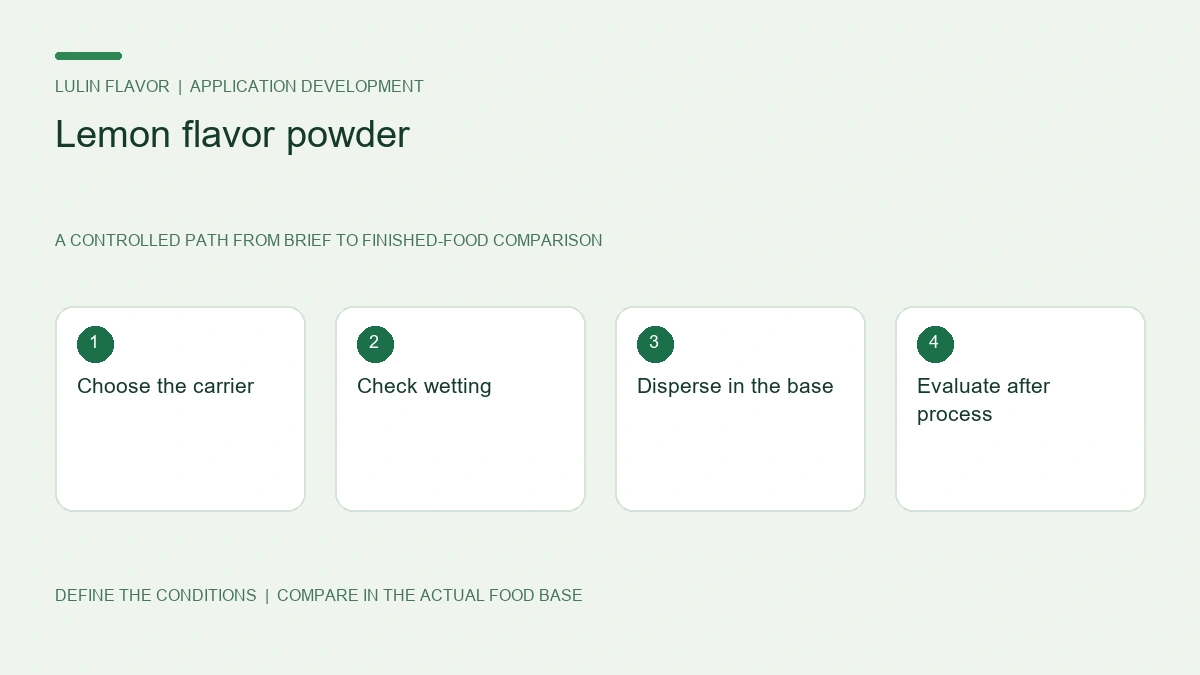
A controlled workflow for this formulation or supplier-review decision.
Copy this protocol into a pilot brief:
- Prepare a no-flavor control, the current reference, and up to four coded candidates in one dry-mix batch. Duplicate each code.
- Screen 0.05%, 0.10%, 0.15%, 0.20%, 0.25%, 0.30%, 0.40%, and 0.50% w/w in the dry mix. Use 0.20% w/w as the design benchmark. Keep 0.50% as a diagnostic high point, not a default production dose.
- For reconstituted drinks, also score 0.10%, 0.15%, and 0.20% w/w in the finished drink. Use 0.15% w/w as the high-end drink reference benchmark.
- Lock water, fat, protein, sugar, salt, acid, mesh, blend time, and serving temperature. Record pH, temperature in °C, and time in min.
- Score top, middle, base, and 30–60 s linger from 0 to 10, plus lemon identity, citral, terpene, soap/oxidized, pith, caking, dust, reconstitution, color, and off-notes.
- Evaluate at the target serving temperature, then after 24 h and 7 days. Add 30 days and 90 days for warehouse-sensitive powders. Run the pH 3.0 / 24 h acid screen on every drink finalist.
| Attribute | 0–10 scoring anchor | Timing | Reject signal |
|---|---|---|---|
| Lemon identity | 0 = absent; 10 = unmistakable selected family | First recognition | Generic orange, lime, solvent, or sour candy replaces lemon |
| Peel / citral top | 0 = absent; 10 = exact Eureka, Meyer, or candy target | 0–2 s | Pine, starch, alcohol solvent, or empty sour |
| Juice / lemonade middle | 0 = hollow; 10 = full but balanced | 2–10 s | Loud aroma with a thin watery middle |
| Finish cleanliness | 0 = dirty; 10 = short and pith-clean | 10–30 s | Soap, furniture polish, long bitter linger |
| Oxidized linger | 0 = clean; 10 = severe p-cymene / p-cresol | 30–60 s | Late pine, phenol, or cardboard |
| Powder handling | 0 = unusable; 10 = free-flowing and uniform | Dry blend | Caking, oil spots, severe dust, segregation |
| Bake, acid, UHT, or freeze survival | 0 = fails process; 10 = target after process | After process | Profile only works in the bag |
| Overall application fit | 0 = reject; 10 = production candidate | Full sample | Fails at serving temperature or after 7 days |
The following pilot matrix turns those rules into starting conditions. Values are reference screens, not legal limits or LULIN FLAVOR guarantees.
| Pilot system | Batch | Dry-mix flavor ladder | Finished-drink check | Fat | Protein | Sugar | Process challenge | Serving check | Storage checks |
|---|---|---|---|---|---|---|---|---|---|
| Instant lemonade | 1 kg | 0.05%, 0.10%, 0.20%, 0.25% | 0.10%, 0.15%, 0.20% | 0%, 1.5% | 0%, 3% | 8%, 10%, 12% | pH 3.0 / 24 h; 20 °C, 60 s stir | 4 °C, 8 °C | 7 days, 30 days |
| Protein shake powder | 1 kg | 0.15%, 0.20%, 0.30%, 0.40% | 0.15%, 0.20% | 1%, 3% | 6%, 10% | 0%, 4%, 8% | 20 °C, 30 s blend | 4 °C, 8 °C | 7 days, 30 days |
| Cookie dry mix | 1 kg | 0.15%, 0.20%, 0.25%, 0.40% | n/a | 10%, 15%, 20% | 5%, 7% | 20%, 25% | 180 °C for 12 min | 20 °C | 24 h, 7 days |
| Cake or muffin mix | 1 kg | 0.10%, 0.20%, 0.25%, 0.30% | n/a | 8%, 12% | 6%, 8% | 18%, 22% | 180 °C for 12 min | 20 °C | 24 h, 7 days |
| Ice cream premix | 1 kg | 0.10%, 0.15%, 0.20%, 0.30% | n/a | 8%, 10%, 12% | 3%, 4% | 12%, 16% | Freeze −18 °C | −12 °C | 7 days, 30 days |
| Candy or gummy powder | 1 kg | 0.15%, 0.20%, 0.25%, 0.40% | n/a | 0%, 2% | 0%, 2% | 60%, 70% | 145 °C boil | 20 °C | 24 h, 7 days |
Do not rank a pH 3.0 / 24 h drink against a 180 °C / 12 min cookie as equal exposure. Advance the lowest dose and simplest construction that still meet the sensory sentence after process. Send the locked base, process, and scorecard through the Food Flavor Sample Request for B2B Buyers route.
Which 21 CFR 101.22 class, documents, and destination details belong in a lemon flavor powder RFQ?
A United States lemon flavor powder RFQ should lock the sensory sentence, 21 CFR 101.22 class, matrix, process, powder handling limits, documents, destination market, and commercial terms before samples are scored. Incomplete briefs produce incomparable powders.
| RFQ block | Details to send | Documents or response to request |
|---|---|---|
| Identity and sensory target | Family name, top/middle/base sentence, forbidden notes, citral vs juice preference | Sample code, sensory description, allergen statement |
| Label class | Natural Flavor, Artificial Flavor, Natural and Artificial Flavor, Naturally Flavored, Artificially Flavored, or With Other Natural Flavor | 21 CFR 101.22 declaration for the exact code |
| Application matrix | Water, fat %, protein %, sugar/Brix, salt, acid, pH, dairy or plant base | Recommended construction and starting dose |
| Process | Blend order, reconstitution, pH 3.0 / 24 h, 72 °C / 15 s, 85 °C / 30 s, 95 °C / 30 s, 135 °C / 4 s, 180 °C bake, 145 °C boil, freeze | Heat, acid, and process stability guidance |
| Powder handling | 20 mesh through 100 mesh target, moisture, aw, bulk density, dust, caking, carrier restrictions, oil load | TDS physical limits, sieve, flow |
| Regulatory and quality | United States label declaration, allergen and cross-contact, GMO, Halal, Kosher, ISO 9001, ISO 22000, HACCP | Signed statements, current certificates, change-control policy |
| Commercial and logistics | Annual volume, trial quantity, 20 kg powder MOQ planning, pack size, lead time, Incoterm, destination, 20 °C storage, 24-month pack target | Price basis, shelf life, packaging, export documents |
For United States distribution, the U.S. Food and Drug Administration treats Natural Flavor, Artificial Flavor, Natural and Artificial Flavor, Naturally Flavored, Artificially Flavored, and With Other Natural Flavor under 21 CFR 101.22, not the catalog name “lemon.” A spray-dried lemon flavor powder is not automatically ISO 855 expressed lemon oil or a 21 CFR 182.20 oil listing. Ask for the identity claim in writing if the finished label will imply juice content or oil identity.
Individual flavor substances may be reviewed under Flavor Extract Manufacturers Association GRAS publications. FEMA status does not replace finished-formula, allergen, or destination-market review. The FEMA flavor safety and labeling resources support substance-level questions only. A lactose carrier fails a dairy-free claim even when the aroma chemicals are synthetic. Ask for those statuses as separate documents.
How does LULIN FLAVOR sample and supply lemon flavor powder for United States plants?
LULIN FLAVOR develops and supplies food-grade lemon flavor powder through application-matched sampling, powder and liquid options, and document support from QUANZHOU LVLIN BIOENGINEERING CO., LTD. The company was established in 2001 in Quanzhou Fujian, China, at Qingmeng Industrial Zone 2-19(E).
The site runs three modernized production lines on more than 8000 m², with more than 50 employees and over a dozen flavor engineers who have over 20 years of flavor-development and application experience. ISO 9001, ISO 22000, and HACCP systems support traceability from raw material to packed powder. An application laboratory prepares Eureka, Lisbon, Meyer, Femminello, candy lemon, lemonade, lemon-curd, and WONF directions as spray-dried powder, plated powder, agglomerated powder, encapsulated powder, or matching liquids and emulsions.
Application samples take 3–5 business days after a complete brief. Powder MOQ starts at 20 kg. Liquid MOQ starts at 25 kg. Standard production takes 10–15 business days after approval. Technical files for a selected code can include TDS, SDS, COA, allergen statement, GMO statement, Halal, Kosher, and United States regulatory wording.
Submit the matrix, process, sensory sentence, mesh target, market, and document list through the sample-request path, or Contact LULIN FLAVOR | Food Flavor Project Inquiries with the dry mix, bake or freeze path, serving temperature, and trial quantity.
Lemon flavor powder FAQ
What is lemon flavor powder?
Lemon flavor powder is a concentrated dry flavoring designed to create a specified Eureka, Lisbon, Meyer, candy, lemonade, or lemon-curd impression at a low use level. It may be supplied as spray-dried powder, plated powder, agglomerated powder, or encapsulated powder. It is not the same material as lemon juice powder, lemon peel, expressed lemon oil, or citric acid.
Is lemon flavor powder the same as lemon juice powder, lemon oil, or citric acid?
No. Lemon flavor powder is a low-dose flavor concentrate on a dry carrier. Lemon juice powder contributes fruit solids, sugar, and acid at a much higher use rate. Expressed lemon oil is an ISO 855 liquid oil. Citric acid supplies sourness with no peel aroma. Quote the identity actually needed.
What dose of lemon flavor powder should a dry mix use?
Screen 0.05%, 0.10%, 0.15%, 0.20%, 0.25%, 0.30%, 0.40%, and 0.50% w/w in the dry mix, and use 0.20% w/w as the design benchmark for the first round. For reconstituted drinks, also check 0.10%, 0.15%, and 0.20% w/w in the finished drink, with 0.15% w/w as the high-end drink reference. Final dose follows the selected code, carrier, and process loss.
Which powder construction should a formulator request first?
Start with spray-dried powder for most dry mixes. Move to agglomerated powder when wetting and sink time fail in the cup. Move to encapsulated powder when 180 °C baking, 135 °C UHT, or a pH 3.0 acid hold strips the peel top. Use plated powder only for short runs or when bag aroma is the commercial signal. Compare liquids and oil-in-water emulsion when the process is wet.
How should a lemon profile be written for a supplier?
Write a timed sentence: onset at 0–2 s, middle at 2–10 s, finish at 10–30 s, oxidized linger at 30–60 s, intensity from 0 to 10, serving temperature, pH, and forbidden notes. Example: “Eureka peel top at 4 °C, juice-led middle, short pith finish, no soap, no pine, intensity 7.” Attach the dry mix, process, and reconstitution method.
Why does lemon flavor powder taste soapy or like furniture polish after storage?
Soapy or furniture-polish lemon usually means citral oxidation or acid rearrangement, not a missing dose. Compare the fresh coded sample with the same code after pH 3.0 / 24 h and after 7 days in the planned pack. p-Cymene, p-cresol, p-methylacetophenone, and α-terpineol mark the defect. Encapsulated powder, lower oil load, foil, and 20 °C storage are the first controls.
Can lemon flavor powder survive baking, acid drinks, or freezing?
Lemon flavor powder can survive baking, acid drinks, or freezing when the construction, family, and addition point match the process. Compare before and after 180 °C for 12 min, pH 3.0 for 24 h, 135 °C for 4 s, or freeze to −18 °C with serving at −12 °C. Peel aldehydes are the first to collapse; pith and terpene last longer.
Is lemon flavor powder the same as lemon-lime flavoring?
No. Lemon flavor powder is a lemon-only concentrate in dry form. Lemon-lime is a blend brief with a different floral-terpene axis. Lock the lemon family and powder construction first, then send combined beverage work to the lemon-lime beverage flavoring page rather than treating lime as a synonym.
What documents belong in a lemon flavor powder RFQ?
Request a current TDS, SDS, lot COA, ingredient and carrier statement, allergen and cross-contact statement, GMO statement, Halal or Kosher certificate when needed, ISO 9001 / ISO 22000 / HACCP information, United States 21 CFR 101.22 labeling declaration, sieve and moisture data, 20 kg MOQ, lead time, packaging, and change-control terms.
How should samples be compared in the real application?
Compare coded samples in one locked dry mix, using a no-flavor control and the current reference. Run the 0.05% through 0.50% ladder with 0.20% w/w as the design benchmark. Score top, middle, base, oxidized linger, handling, and process survival at the real serving temperature, then again after 7 days. Bag aroma alone is not a production decision.
Lemon flavor powder selection brief for the next sample round
Send one sensory sentence, the dry-mix formula, reconstitution or bake or freeze path, serving temperature, pH, and a 0-to-10 scorecard. Screen 0.05%, 0.10%, 0.15%, 0.20%, 0.25%, 0.30%, 0.40%, and 0.50% w/w. Use 0.20% w/w as the design benchmark and 80 mesh (177 µm) as the handling benchmark. Specify spray-dried powder unless wetting, heat, acid, or bag aroma forces agglomerated powder, encapsulated powder, or plated powder. Carry only the surviving code into document, 20 kg MOQ, 24-month pack, 10-fold oil-feed comparison, and 10–15 business day production review.
Develop this flavor in your product
Send your product, target market and project goal. We will review the sample direction with you.