Published
Milk Flavor Powder: Delivery Format, Release, and Application Testing
Milk flavor powder is a dry flavor system that delivers a specified fresh-milk, cream, cooked-milk, or milk-tea note in dry mixes and reconstituted foods. Screen 0.05%, 0.10%, 0.15%, 0.20%, 0.25%, 0.30%, 0.40%, and 0.50% w/w, using 0.30% w/w as the design benchmark.
Milk: a sensory reference for defining the target flavor profile.
What is milk flavor powder, and how does it differ from dairy ingredients?
Milk flavor powder is a concentrated dry flavoring that supplies a specified milk, cream, or cooked-milk impression at a low use level, whereas milk powder, cream powder, and dairy solids contribute protein, fat, lactose, and bulk. A 0.30% w/w flavor addition is a sensory tool. A 10% or 20% milk-powder addition is a solids, nutrition, and labeling decision.
| Material | Primary job | Typical use band | Allergen and label consequence |
|---|---|---|---|
| Milk flavor powder | Aroma and taste at low dose | 0.05% to 0.50% w/w in dry mix | May be dairy-free or dairy-containing; follows the exact code |
| Skim Milk powder | Protein, lactose, minerals, cooked-milk background | 5% to 25% of a dry mix | Milk allergen; dairy ingredient declaration |
| Whole Milk powder | Fat, protein, lactose, richer cooked-milk | 5% to 20% of a dry mix | Milk allergen; dairy fat on the label |
| Cream powder | Fat and dairy mouthfeel | 2% to 15% of a dry mix | Milk allergen; high fat |
| Sweetened Condensed solids | Sugar, cooked-milk, viscosity | Formula-specific | Milk allergen plus sugar load |
Compare cost as grams of flavor per kilogram of finished food, then add dairy solids only when those solids are required. The Flavor Powder for Food Production page covers dry-format handling. This page stays with the milk profile, powder delivery, and application test. Broader dairy navigation sits on Dairy Flavors for B2B Food Applications.
How should a milk flavor profile be specified without vague dairy adjectives?
A milk flavor powder brief becomes usable when it names onset, heart, finish, intensity, and forbidden notes rather than “creamy,” “authentic,” or “rich.” Those words do not tell a flavorist which lactone, cooked-milk, butter, or fatty-acid direction to build.
Write the profile as a time sequence. Onset (0–5 s) is fresh milk, steamed milk, light cream, or cooked UHT milk. Middle (5–20 s) is cream body, condensed-milk sweetness, milk-tea dairy support, or a thin skim impression. Finish (20–60 s) is a short clean milk, or a defect such as butter popcorn, cheese, cardboard, or a waxy film. Score each tier from 0 (absent) through 1, 2, 3, 4, 5, 6, 7, 8, 9, to 10 (dominant), and record duration in seconds.
A working sentence looks like this: “Fresh pasteurized-milk top at 4 °C, cream-lactone middle without diacetyl popcorn, short sweet finish by 20 s, no cooked Dimethyl Sulfide, no cheesy fatty acid, intensity 7 in a 12% solids reconstituted drink.”
Useful negatives include “no butter popcorn,” “no goat note,” “no evaporated-milk,” and “no cereal cardboard.” Delta and gamma lactones support cream and condensed-milk body. Diacetyl and acetoin add butter lift; a little reads as cream, a lot reads as popcorn. Dimethyl Sulfide and methional mark cooked or UHT milk. Vanillin, maltol, and Ethyl Maltol sweeten cooked-milk. Hexanoic, octanoic, and decanoic acids turn a milk brief into cheese when they sit too high.
Serve the sample at the real temperature. A reconstituted drink at 4 °C hides volatile top notes that become obvious at 20 °C. A hot milk tea at 65 °C pushes cooked-milk and caramel. Record color, haze, mouthfeel, and aroma separately so a whiter powder is not scored as stronger milk.
Which top, middle, and base notes change a milk flavor powder brief?
Top notes set fresh-milk recognition, middle notes set cream or cooked-milk body, and base notes determine whether the finish tastes clean, condensed, buttery, or stale. Pick one lead direction in each tier. Asking for fresh milk, condensed milk, cream, butter, and baked milk in one code produces a muddy sample.
| Note tier | Directions to test | Useful applications | Failure signal | Adjustment lever |
|---|---|---|---|---|
| Top / 0–5 s | Fresh pasteurized milk, steamed milk, light cream, faint vanilla | Instant milk drink, milk tea, cold shake powder | Opens like raw starch, solvent, or empty sweetness | Raise volatile milk lift; cut heavy cooked or butter materials |
| Middle / 5–20 s | Cream lactone, condensed milk, light butter, cooked UHT milk | Bakery mix, confectionery, creamer-style premix | Tastes sweet or fatty without reading as milk | Add lactone body; trim generic vanilla or caramel |
| Base / 20–60 s | Sweet whey impression, condensed sweetness, restrained caramel, short dairy fat | Toffee, chocolate filling, baked milk cookie | Cheese, goat, cardboard, waxy film, or long butter | Cut fatty acids and diacetyl; shorten the finish |
Six commercial families cover most powder briefs:
- Fresh pasteurized milk: light, slightly cooked, short finish for cold drinks.
- Cream: lactone-rich middle, low diacetyl, longer fatty finish for bakery and premium drink powders.
- Cooked / UHT milk: Dimethyl Sulfide and methional on top when the food is already heat-treated.
- Condensed milk: sweet lactone, maltol, light caramel for confectionery and sweet bakery.
- Milk-tea dairy note: restrained milk that supports tea rather than replacing it.
- Plant-base milkiness: cream-lactone impression without dairy solids, built to cover oat, soy, or almond off-notes.
A Hong Kong milk-tea powder needs a clean dairy middle that survives 65 °C brewing water. A sandwich-cookie cream needs a longer lactone finish after 180 °C bake. A plant oat drink needs milkiness that does not add a milk allergen. Write the family name into the RFQ. Do not borrow cheese, butter, yogurt, or vanilla ice-cream language unless that is the actual target.
Which powder construction and solubility option should a formulator test first?
Formulators should test milk flavor powder as spray-dried powder, plated powder, agglomerated powder, or encapsulated powder, and should compare those dry options against water-soluble liquid, oil-soluble liquid, oil-dispersible liquid, and oil-in-water emulsion when the process is not dry-only. The milk name does not select the delivery system. The continuous phase, addition point, heat, and warehouse humidity do.
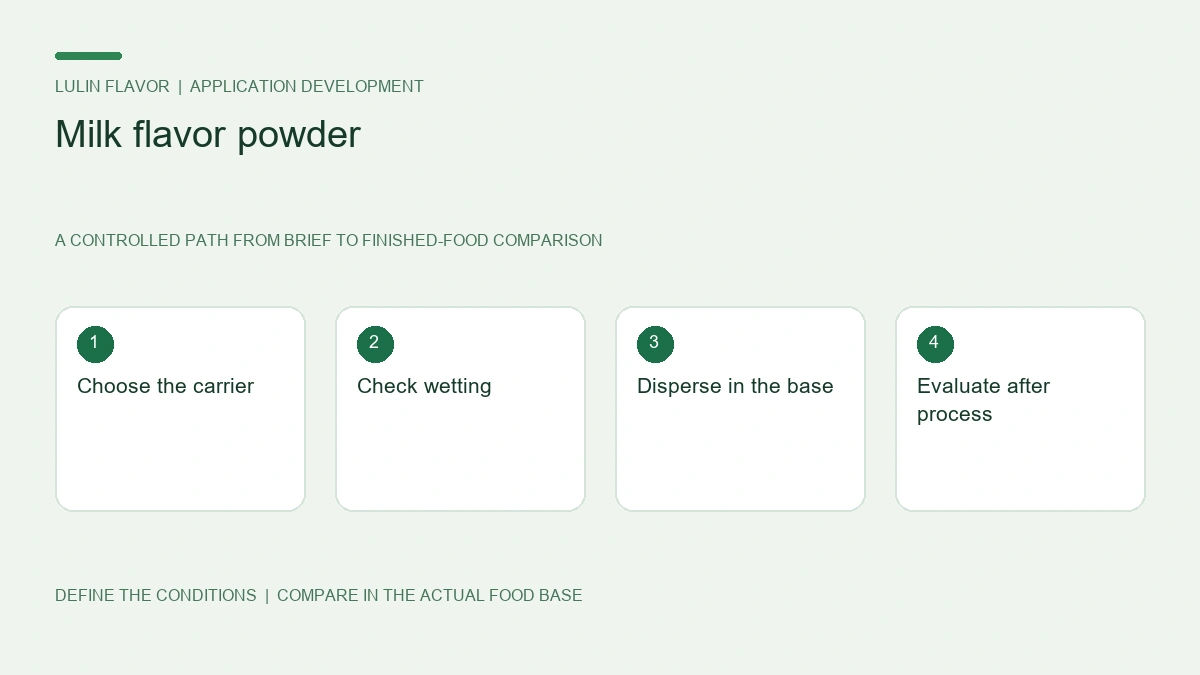
A controlled workflow for this formulation or supplier-review decision.
| Format option | Best first fit | Main advantage | Failure mode to test |
|---|---|---|---|
| spray-dried powder | Instant drink mix, bakery premix | Dry dosing, protected volatiles, even blending | Caking, dust loss, weak reconstitution, carrier sweetness |
| plated powder | Short runs, low-heat dry blends | Simple manufacture, fast aroma in the bag | Volatile loss in storage, hot spots, oily specks |
| agglomerated powder | Instant beverages that must wet and sink | Faster wetting than a fine spray-dry | Fragile granules, fines after conveying |
| encapsulated powder | Baking, UHT, delayed release | Protects selected notes until heat or moisture | Incomplete release, carrier-heavy taste |
| water-soluble liquid | Tank-dosed drinks, syrups, wet fillings | Fast dispersion, easy bench titration | Heat stripping, no dry-blend path |
| oil-soluble liquid | Fat fillings, compound coating, high-fat bakery | Holds lactones and fatty notes in fat | Haze or ring in a low-fat drink |
| oil-dispersible liquid | Coatings and mixed-fat systems | Spreads through oil without full molecular solubility | Settling, uneven spray |
| oil-in-water emulsion | Dairy drinks, plant drinks, cream-style beverages | Carries oil-phase aroma through water | Creaming, ring, freeze–thaw break |
For a dry mix, start with spray-dried powder. Plate when bag aroma must be loud or a spray-dry lot is not available. Agglomerate when the cup shows floating fines. Encapsulate when 180 °C baking or 135 °C UHT strips the fresh-milk top.
Carrier chemistry is part of the flavor. Maltodextrin is commonly supplied at DE 10, DE 12, DE 15, DE 18, and DE 20. Lower DE (DE 10, DE 12) is less sweet; higher DE (DE 18, DE 20) sprays more readily and can taste thin. Gum Arabic and OSA Modified Starch improve encapsulation. Lactose can add dairy body and a milk allergen. Glucose syrup solids raise hygroscopicity. Silicon dioxide is an anti-caking aid, not a flavor.
Write particle size on an ASTM E11 stack: 20 mesh (841 µm), 40 mesh (400 µm), 60 mesh (250 µm), 80 mesh (177 µm), and 100 mesh (149 µm). Use 80 mesh (177 µm) as the handling benchmark. A 20 mesh cut is too coarse for a drink mix; a 100 mesh cut dusts and can segregate.
Set moisture at 3%, 4%, 5%, or 6%, with 5% as the maximum design benchmark. Set water activity at 0.20, 0.25, 0.30, 0.35, or 0.40, with 0.30 as the maximum. Screen bulk density at 0.35 g/mL, 0.45 g/mL, 0.55 g/mL, and 0.65 g/mL; 0.45 g/mL is a flowable midpoint. Screen warehouse temperature at 15 °C, 20 °C, and 25 °C; use 20 °C as the storage benchmark.
The Powder vs Liquid Food Flavors page holds the general format comparison. Keep the milk sensory sentence constant so construction remains the only test variable.
How do water, fat, protein, sugar, salt, acid, and serving temperature change milk flavor powder?
Water, fat, protein, sugar, salt, acid, and serving temperature change milk flavor powder by altering volatile release, mouthfeel cues, cooked-note balance, and the point at which fatty acids or lactones become cheesy rather than milky. A water tasting can expose defects. Approval still requires the real base.
| Matrix variable | Controlled screening bracket | Likely sensory effect |
|---|---|---|
| Water / total solids | Reconstitute at target, then −10% and +10% solids | Dilution thins cream body; high solids slow release |
| Fat | 0%, 1.5%, 3.5%, and 10% fat | Retains lactones; mutes fresh top; can delay aroma |
| Protein | 0%, 3%, 6%, and 10% protein | Binds aroma; adds cooked dairy, beany, or powdery notes |
| Sugar / sweetener | 0%, 4%, 8%, and 12% sugar equivalent | Softens cooked notes; excess shifts milk toward condensed or caramel |
| Salt | 0%, 0.05%, 0.15%, and 0.30% NaCl | Low salt can clean a cooked note; high salt turns milk savory |
| Acid / pH | pH 4.5, 5.5, 6.6, and 7.0 when safe | Acid brightens top notes and can curdle protein or split emulsions |
| Serving temperature | 4 °C, 8 °C, 20 °C, 45 °C, and 65 °C | Cold suppresses aroma; heat increases cooked-milk and caramel |
Change one variable at a time. A 3.5% fat Whole Milk model and a 0% fat Skim Milk model will not release the same lactone balance at 0.30% w/w. Raising dose in the skim model to chase creaminess often brings diacetyl or fatty acids first. Casein and whey bind volatiles; pea, soy, and oat proteins add beany or cereal notes. If the opening disappears while the finish turns powdery, change construction before climbing from 0.30% to 0.50%.
Lock the sweetener system during supplier comparisons. At 12% sucrose a condensed-milk code can look correct; the same code in a 0% sugar plant drink can read as stale. Score chilled drinks at 4 °C and 8 °C, bakery at 20 °C, milk tea at 65 °C, and frozen desserts near −12 °C.
For flavored milk drinks, send the dairy or plant base to Milk Beverage Flavors for B2B Drinks after the powder construction is chosen.
Which processing and storage conditions flatten or shift a milk powder profile?
Heat, shear, oxygen, humidity, and warehouse temperature can strip fresh-milk top notes from milk flavor powder while leaving cooked, caramel, or waxy notes behind. Judge the processed sample. The neat powder in a jar is a receiving check, not a production decision.
| Stress condition | Likely change | Controlled comparison | Corrective direction |
|---|---|---|---|
| Dry blending and reconstitution | Dust loss, segregation, floating fines | Bag versus blend at 0 min and 30 min; 15 s, 30 s, and 60 s after stirring at 20 °C | 80 mesh cut, agglomerated grade, dust control |
| HTST 72 °C / 15 s | Loss of fresh top, rise in cooked milk | Before heat versus after 72 °C for 15 s | Encapsulated top note or post-heat liquid add |
| Hot fill 85 °C / 30 s or 95 °C / 30 s | Stronger UHT character, thinner cream | Matched hold at 85 °C and 95 °C | Cooked-milk family instead of fresh-milk family |
| UHT 135 °C / 4 s | Fresh milk collapses; methional and caramel rise | Direct UHT cycle on the real formula | Encapsulated powder or a cooked-milk code |
| Baking 180 °C / 12 min | Volatile loss, Maillard interaction | Dough versus cooled cookie at 20 °C | Encapsulated powder; shift middle/base |
| Freezing to −18 °C, serve at −12 °C | Muted aroma, possible lactose sand | Mix, freezer, and serving scoop | Higher lactone middle; see ice cream powder page |
| Humidity, oxygen, warehouse | Caking, cardboard, stale fat, volatile loss | 25 °C / 60% RH versus sealed 20 °C; 0 days, 7 days, 30 days, 90 days | Moisture ≤ 5%, aw ≤ 0.30, barrier pack, 20 °C on the COA |
Never transfer a liquid dose number onto a powder. A 0.10% water-soluble liquid and a 0.30% spray-dried powder are not the same active load; carrier solids dilute the flavor. Convert both to grams of flavor per kilogram of finished food, or run a matched sensory ladder.
High-boil sugar at 145 °C is a different challenge from a 40 °C chocolate filling. Send candy-specific powder work to Candy Flavor Powder for Food Buyers after the milk family is chosen. Frozen-dessert handling belongs on Ice Cream Flavor Powder for Food Buyers. Keep powders sealed and dry. Use 20 °C as the warehouse screen. Record odor, color, flow, reconstitution, and intensity at 0 days, 7 days, 30 days, and 90 days.
How should buyers compare milk flavor powder samples in the real dry mix and finished food?
Buyers should compare coded milk flavor powder samples in the actual dry mix and after the planned reconstitution, bake, freeze, or drink process, not by smelling the bag. An application-matched dose ladder is the purchasing signal.
Copy this protocol into a pilot brief:
- Prepare a no-flavor control, the current reference, and up to four coded candidates in one dry-mix batch. Duplicate each code.
- Screen 0.05%, 0.10%, 0.15%, 0.20%, 0.25%, 0.30%, 0.40%, and 0.50% w/w in the dry mix. Use 0.30% w/w as the design benchmark. Keep 0.50% as a diagnostic high point, not a default production dose.
- For reconstituted drinks, also score 0.10%, 0.15%, and 0.20% w/w in the finished drink. Use 0.20% w/w as the high-end drink reference benchmark.
- Lock water, fat, protein, sugar, salt, acid, mesh, blend time, and serving temperature. Record pH, temperature in °C, and time in min.
- Score top, middle, and base from 0 to 10, plus cream body, cooked-milk, butter, cheese/goat, caking, dust, reconstitution, color, and off-notes.
- Evaluate at the target serving temperature, then after 24 h and 7 days. Add 30 days and 90 days for warehouse-sensitive powders.
Score milk identity, top, middle, finish, handling, and process survival from 0 to 10. Reject a sample that smells like generic vanilla or creamer, opens as solvent or starch, finishes as cheese or cardboard, cakes in the blender, or only works in the bag.
The following pilot matrix turns those rules into starting conditions. Values are reference screens, not legal limits or LULIN FLAVOR guarantees.
| Pilot system | Batch | Dry-mix flavor ladder | Finished-drink check | Fat | Protein | Sugar | Process challenge | Serving check | Storage checks |
|---|---|---|---|---|---|---|---|---|---|
| Instant milk drink | 1 kg | 0.05%, 0.10%, 0.20%, 0.30% | 0.10%, 0.15%, 0.20% | 0%, 1.5%, 3.5% | 0%, 3%, 6% | 8%, 10%, 12% | 20 °C, 60 s stir | 4 °C, 8 °C | 7 days, 30 days |
| Milk-tea dairy note | 1 kg | 0.10%, 0.20%, 0.30%, 0.40% | 0.10%, 0.15%, 0.20% | 0%, 1.5%, 3.5% | 0%, 3% | 6%, 8%, 10% | 65 °C water, 3 min | 45 °C, 65 °C | 24 h, 7 days |
| Plant oat or soy drink | 1 kg | 0.15%, 0.20%, 0.30%, 0.40% | 0.15%, 0.20% | 1%, 3% | 3%, 6%, 10% | 0%, 4%, 8% | 135 °C for 4 s | 4 °C, 20 °C | 7 days, 30 days |
| Cookie dry mix | 1 kg | 0.15%, 0.20%, 0.30%, 0.50% | n/a | 10%, 15%, 20% | 5%, 7% | 20%, 25% | 180 °C for 12 min | 20 °C | 24 h, 7 days |
| Ice cream premix | 1 kg | 0.10%, 0.20%, 0.30%, 0.40% | n/a | 8%, 10%, 12% | 3%, 4% | 12%, 16% | Freeze −18 °C | −12 °C | 7 days, 30 days |
Do not rank a 72 °C / 15 s milk against a 135 °C / 4 s plant drink as equal exposure. Advance the lowest dose and simplest construction that still meet the sensory sentence after process. Send the locked base, process, and scorecard through the Food Flavor Sample Request for B2B Buyers route.
What belongs in a United States milk flavor powder RFQ?
A United States milk flavor powder RFQ should lock the sensory sentence, matrix, process, powder handling limits, documents, destination market, and commercial terms before samples are scored. Incomplete briefs produce incomparable powders.
| RFQ block | Details to send | Documents or response to request |
|---|---|---|
| Identity and sensory target | Family name, top/middle/base sentence, forbidden notes, natural or artificial preference | Sample code, sensory description, allergen statement |
| Application matrix | Water, fat %, protein %, sugar/Brix, salt, acid, pH, dairy or plant base | Recommended construction and starting dose |
| Process | Blend order, reconstitution, 72 °C / 15 s, 85 °C / 30 s, 95 °C / 30 s, 135 °C / 4 s, 180 °C bake, freeze | Heat and process stability guidance |
| Powder handling | 20 mesh through 100 mesh target, moisture, aw, bulk density, dust, caking, carrier restrictions | TDS physical limits, sieve, flow |
| Regulatory and quality | United States label declaration, allergen and cross-contact, GMO, Halal, Kosher, ISO 9001, ISO 22000, HACCP | Signed statements, current certificates, change-control policy |
| Commercial and logistics | Annual volume, trial quantity, 20 kg powder MOQ planning, pack size, lead time, Incoterm, destination, 20 °C storage | Price basis, shelf life, packaging, export documents |
For United States distribution, “natural flavor” and “artificial flavor” follow 21 CFR 101.22, not the catalog name “milk.” Natural flavor may derive from dairy, plant, fermentation, or other listed sources; artificial flavor is not derived from those natural sources. Either class can still contain a milk allergen. Read the FDA flavor-labeling rule in 21 CFR 101.22 against the exact code.
Individual flavor substances may be reviewed under Flavor Extract Manufacturers Association GRAS publications. FEMA status does not replace finished-formula, allergen, or destination-market review; see the FEMA flavor safety and labeling resources. A lactose carrier fails a dairy-free claim even when the aroma chemicals are synthetic. A dairy-derived natural milk flavor fails vegan.
How does LULIN FLAVOR support milk flavor powder from sample to production?
LULIN FLAVOR develops and supplies food-grade milk flavor powder through application-matched sampling, powder and liquid options, and document support from QUANZHOU LVLIN BIOENGINEERING CO., LTD. The company was established in 2001 in Quanzhou Fujian, China, at Qingmeng Industrial Zone 2-19(E).
The site runs three modernized production lines on more than 8,000 m², with more than 50 employees and over a dozen flavor engineers who have over 20 years of flavor-development and application experience. ISO 22000 and HACCP systems support traceability. An application laboratory prepares fresh-milk, cream, cooked-milk, condensed-milk, milk-tea dairy, and plant-base milkiness directions as spray-dried powder, plated powder, agglomerated powder, encapsulated powder, or matching liquids.
Application samples take 3–5 business days after a complete brief. Powder MOQ starts at 20 kg. Liquid MOQ starts at 25 kg. Standard production takes 10–15 business days after approval. Technical files for a selected code can include TDS, SDS, COA, allergen, GMO, Halal, Kosher, and United States regulatory wording.
Submit the matrix, process, sensory sentence, mesh target, market, and document list through the sample-request path, or Contact LULIN FLAVOR for Food Flavor Project Inquiries with the dry mix, reconstitution method, heat profile, serving temperature, and trial quantity.
Milk flavor powder FAQ
What is milk flavor powder?
Milk flavor powder is a concentrated dry flavoring designed to create a specified fresh-milk, cream, cooked-milk, condensed-milk, or milk-tea dairy impression at a low use level. It may be supplied as spray-dried powder, plated powder, agglomerated powder, or encapsulated powder, and it is not milk powder or a complete dairy creamer.
Is milk flavor powder the same as milk powder?
No. Milk flavor powder is a low-dose flavor concentrate on a dry carrier, while milk powder is a dairy ingredient that contributes protein, lactose, fat, minerals, and bulk. A typical flavor screen sits at 0.05% to 0.50% w/w, whereas milk powder is used at several percent of the formula.
What dose of milk flavor powder should a dry mix use?
Screen 0.05%, 0.10%, 0.15%, 0.20%, 0.25%, 0.30%, 0.40%, and 0.50% w/w in the dry mix, and use 0.30% w/w as the design benchmark for the first round. For reconstituted drinks, also check 0.10%, 0.15%, and 0.20% w/w in the finished drink, with 0.20% w/w as the high-end drink reference. Final dose follows the selected code, carrier, and process loss.
Which powder construction should a formulator request first?
Start with spray-dried powder for most dry mixes. Move to agglomerated powder when wetting fails in the cup, and to encapsulated powder when 180 °C baking or 135 °C UHT strips the fresh top. Use plated powder for short runs or bag aroma. Compare liquids and oil-in-water emulsion when the process is wet.
Does milk flavor powder contain milk allergens?
Milk flavor powder may be dairy-free or dairy-containing. The name does not decide allergen status. Lactose carriers, dairy-derived natural flavor materials, milk solids, and shared-equipment cross-contact can each introduce milk, so request the exact code’s allergen statement before making a dairy-free or vegan claim.
How should a milk profile be written for a supplier?
Write a timed sentence: onset at 0–5 s, middle at 5–20 s, finish at 20–60 s, intensity from 0 to 10, serving temperature, and forbidden notes. Example: “Fresh pasteurized-milk top at 4 °C, cream-lactone middle, short clean finish, no diacetyl popcorn, no cheese, intensity 7.”
Can milk flavor powder survive UHT, baking, or freezing?
Milk flavor powder can survive UHT, baking, or freezing when the construction, family, and addition point match the process. Compare before and after 135 °C for 4 s, 180 °C for 12 min, or freeze-to −18 °C with serving at −12 °C. Fresh-milk tops are the first to collapse; cooked-milk and condensed-milk middles last longer.
Why does milk flavor taste cooked, cheesy, or thin after processing?
Heat raises Dimethyl Sulfide and methional, which read as cooked or UHT milk. Excess diacetyl reads as butter popcorn. Free fatty acids read as cheese or goat. Thinness usually means the dose, fat, or lactone middle is too low; fix the family and construction before climbing past 0.30% w/w.
What documents belong in a milk flavor powder RFQ?
Request a current TDS, SDS, lot COA, ingredient and carrier statement, allergen and cross-contact statement, GMO statement, Halal or Kosher certificate when needed, ISO 9001 / ISO 22000 / HACCP information, United States 21 CFR 101.22 labeling declaration, sieve and moisture data, 20 kg MOQ, lead time, packaging, and change-control terms.
How should samples be compared in the real application?
Compare coded samples in one locked dry mix, using a no-flavor control and the current reference. Run the 0.05% through 0.50% ladder with 0.30% w/w as the design benchmark. Score top, middle, base, handling, and process survival at the real serving temperature, then again after 7 days. Bag aroma alone is not a production decision.
Milk flavor powder selection brief for the next sample round
Send one sensory sentence, the dry-mix formula, reconstitution or bake or freeze path, serving temperature, and a 0-to-10 scorecard. Screen 0.05%, 0.10%, 0.15%, 0.20%, 0.25%, 0.30%, 0.40%, and 0.50% w/w. Use 0.30% w/w as the design benchmark. Specify spray-dried powder unless wetting, heat, or bag aroma forces agglomerated powder, encapsulated powder, or plated powder. Carry only the surviving code into document, 20 kg MOQ, and 10–15 business day production review.
Develop this flavor in your product
Send your product, target market and project goal. We will review the sample direction with you.