Published
Blueberry Flavoring
Blueberry flavoring is a formulated food flavor system for fresh, wild, jammy, baked, creamy, or candy-like berry character. Screen liquid at 0.05%, 0.10%, 0.20%, and 0.40% w/w; screen powder or emulsion at 0.25%, 0.50%, 0.75%, and 1.00%. Use 0.50% w/w (5 g/kg) as the high-end design benchmark, then optimize in the real matrix and process.
Last updated: 2026-08-31
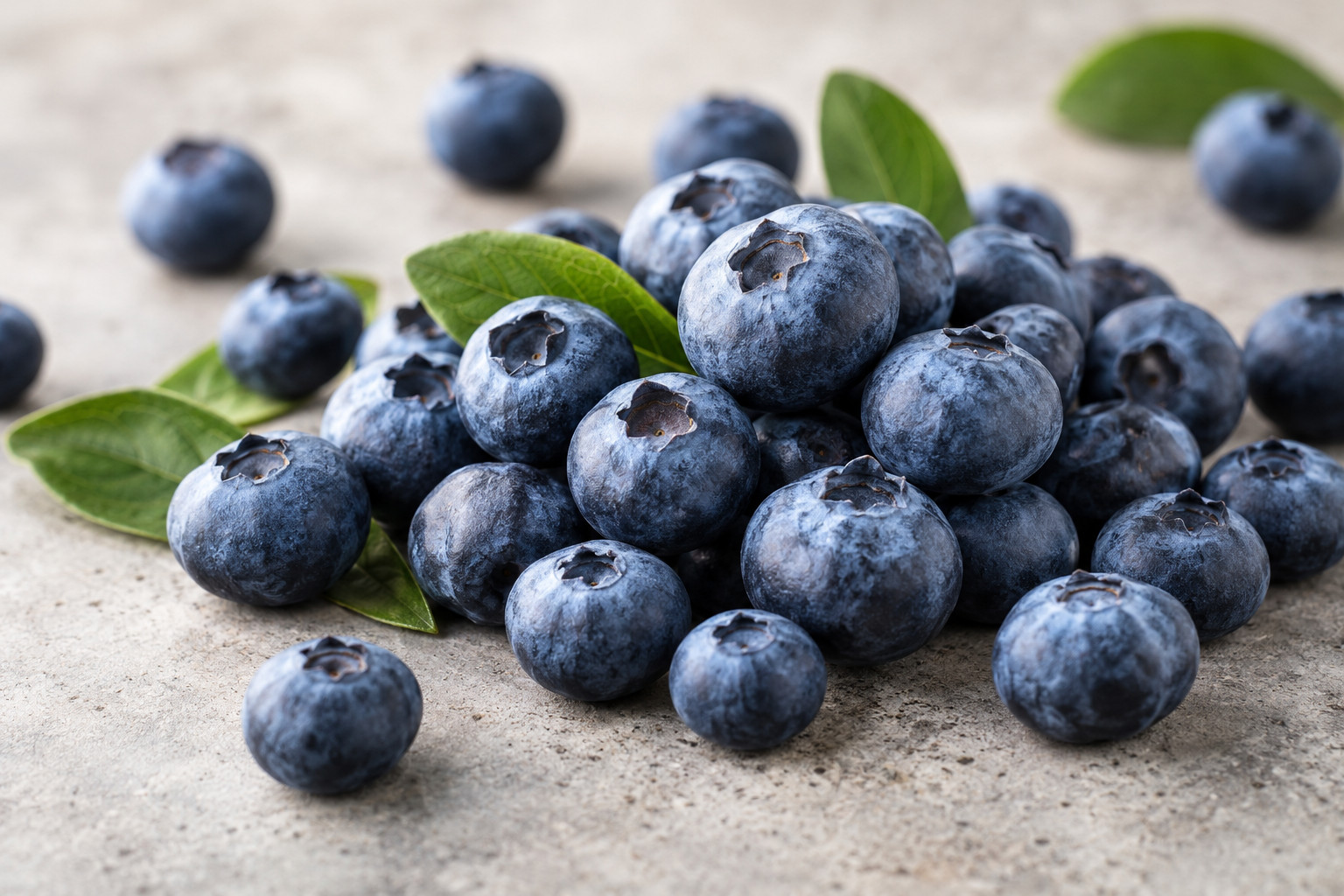
Blueberries: a sensory reference for defining the target flavor profile.
How should a buyer describe a blueberry flavor profile without vague adjectives?
Precision comes first. Brief blueberry flavoring as a sensory sequence: fruit reference, onset, body, acidity, sweetness, finish, color, and process point. “Strong blueberry” is not a specification; drinks, muffin fillings, yogurt, and sour candy require different compositions.
Use a one-sentence target that a flavorist and a sensory panel can score. Example: “Ripe highbush blueberry, floral lift in the first 2 seconds, round berry body through the mid-palate, soft citric tartness, and a clean jam finish at 4 °C.” Add whether blueberry leads or supports lemon, lime, strawberry, raspberry, vanilla, chocolate, mint, or cream.
| Profile dimension | Options to state in the brief | Check in the finished product |
|---|---|---|
| Fruit reference | Cultivated highbush, wild berry, bilberry-style, or blended berry | Identity at aroma and first sip; rule out generic grape or blackcurrant |
| Ripeness | Green-fresh, ripe, overripe, cooked, or dried-fruit | Crispness versus jam depth after processing |
| Opening | Floral, juicy, green, candy, or low-aroma | Recognition before swallowing and at 0–2 s |
| Mid-palate | Skin, pulp, juice, dark berry, or creamy fruit | Body at 2–10 s in the actual base |
| Acidity | Soft, balanced, bright, or sour-candy | Tartness at the final pH, not in plain water |
| Sweetness | Low, balanced, jam-like, or confectionery | Sweetness timing and syrupy aftertaste |
| Finish | Clean, tart, jammy, vanilla-linked, cooked, or lingering | Character at 10–60 s; no medicinal or woody tail |
| Appearance | Clear, cloudy, purple, blue-purple, or no color contribution | Separate visual expectation from aroma intensity |
Blueberry is not the same as blueberry juice, puree, or a fruit-solids concentrate. A flavor system can supply aroma and taste while the formula supplies color, pulp, sugar, and acid. A 2022 Food Research International study linked consumer-preferred blueberry aroma to a group of terpenoid volatiles including linalool, myrtenal, geranyl acetate, and β-myrcene; the study is useful chemistry context, not a recipe. Read the study when a technical team wants to connect aroma language with analytical work.
The words “natural,” “artificial,” and “natural flavor” depend on the selected composition and destination-market rules. They should not be inferred from the word blueberry or from a supplier’s product nickname. The B2B guide to artificial flavor explains that labeling boundary. The food-manufacturing flavor concentrate category covers broader format navigation; this page stays focused on blueberry sensory, matrix, process, and sample decisions.
Which top, middle, and base notes can change a blueberry brief?
Timing defines the profile. Top establishes identity, middle carries fruit body, and base determines the finish. Wrong timing can leave a cold drink with a fleeting opening, empty middle, or cooked tail.
Top notes move first. They occupy the headspace and 0–2 seconds. Fresh beverages often need berry lift with restrained floral or green character. Citrus can sharpen a sparkling drink; a heavy candy top can disconnect aroma from taste. Evaluate cold drinks at 4 °C.
Middle notes carry body. They create recognizable berry from 2–10 seconds. Fat, protein, starch, and gums may suppress ripe juice, soft skin, pulp, or dark-berry character. More top note makes aroma louder; it does not fill an empty middle.
Base notes define persistence. Jam, cooked fruit, vanilla, cream, crust, or earth can anchor the finish. Baked goods accept warmth; carbonated drinks need cleaner tails; yogurt may need cream. Excess base reads as prune, raisin, wood, or medicine.
| Blueberry direction | Top | Middle | Base and finish | First applications |
|---|---|---|---|---|
| Fresh beverage | Bright berry, light floral | Juicy skin and clean fruit | Short tart finish | Still drinks, sparkling water, tea |
| Wild or dark berry | Concentrated berry, green edge | Dark skin and berry depth | Earthy-jam persistence | Juice blends, sauces, kombucha-style drinks |
| Jam and bakery | Ripe fruit, gentle cooked lift | Pulp, sugar, and jam body | Cooked fruit, vanilla, crust | Muffins, fillings, syrups |
| Dairy dessert | Soft fruit opening | Round berry through cream | Sweet-tart creamy finish | Yogurt, ice cream, milkshakes |
| Confectionery | Fast berry impact, clear acid | Candy fruit body | Clean sweet-tart tail | Gummies, hard candy, chews |
When blueberry is blended with another fruit, state the role: “blueberry leads over lemon,” “raspberry supports the mid-palate,” or “vanilla rounds the finish.” That sentence prevents a sample from being judged against three different targets.
How do water, fat, protein, sugar, salt, acid, and serving temperature alter perception?
Matrix fit comes first. Compare blueberry release in the production base at measured pH, soluble solids, protein, fat, and serving temperature; water is only a triage medium.
| Variable | Typical sensory effect | Practical first bracket | Measurements to retain |
|---|---|---|---|
| Water phase | Dilution can thin aroma and taste; dissolved solids slow release | Production dilution plus 0%, 5%, and 10% soluble solids | Total solids, clarity, dilution method |
| Fat | Softens acid and can delay hydrophobic aroma release | 0%, 3%, and 10% fat when the product allows | Fat source, emulsion state, mouth-coating |
| Protein | Can bind aroma, increase bitterness, or add a beany note | 0%, 2%, and 8% protein in a beverage model | Protein source, hydration time, viscosity |
| Sugar and sweetener | Adds body and suppresses sharp acid; can bury freshness | 5%, 10%, and 15% soluble solids, or the actual ladder | °Brix, sweetener identity, sweetness timing |
| Salt and minerals | Low levels can lift sweetness; minerals can expose metallic notes | 0%, 0.05%, and 0.15% salt-equivalent where permitted | Salt species, conductivity, mineral load |
| Acid and pH | Shifts protein charge, sourness, and release | pH 3.0, 3.5, 4.0, 4.5, or 5.0; acid at 0.30%, 0.35%, 0.40%, 0.45%, or 0.50% where permitted | pH to 0.1 unit, titratable acidity, hold time |
| Temperature | Cold mutes aroma; warmth raises volatility and cooked notes | 4 °C, 20 °C, 25 °C, and the planned 60 °C hot condition | Sample temperature and equilibration time |
Lock the beverage first. Hold acid, sweetness, carbonation, and fill condition constant. Lower pH can brighten blueberry; high solids can mute tartness; carbonation can shorten the finish.
Protein changes release. Milk, pea, or soy protein and minerals can suppress fruit or add aftertaste. Fat delays some oil-compatible notes; hydrocolloids change coating. Record hydration and shear.
Salt is secondary. It still matters in electrolyte drinks and savory fruit sauces. Test refrigerated products at 4 °C, shelf-stable products at 20 °C or 25 °C, and hot products at their serving condition. Score onset, body, and finish.
Which liquid, powder, emulsion, oil-soluble, or water-soluble options merit testing?
Format follows the phase. Liquid may be water-soluble, oil-soluble, or emulsified; powder may be spray-dried, carrier-based, or encapsulated. State the carrier, dosing route, and reconstitution behavior.
| Format | Good first fit | Main benefit | Failure modes to screen |
|---|---|---|---|
| Water-soluble liquid | Clear drinks, syrups, jellies, water fillings | Fast wet-tank dispersion and easy dose adjustment | Haze, precipitation, acid shift, heat loss |
| Oil-soluble liquid | Chocolate, fat fillings, coatings, oils | Carries berry character through a fat phase | Oil ring, poor aqueous dispersion, delayed release |
| Emulsion | Cloudy beverages, dairy, sauces, bakery creams | Controlled dispersion and body in water | Separation, viscosity change, homogenization dependence |
| Powder | Dry beverage mixes, bakery premixes, seasonings | No added process water; dry dosing | Caking, dust, segregation, slow hydration |
| Encapsulated powder | High heat, oxygen-sensitive, or delayed-release products | Protects volatile notes and controls release | Late release, carrier taste, particle-mouthfeel impact |
For a first application screen, test a liquid at 0.05%, 0.10%, 0.20%, and 0.40% w/w and a powder at 0.25%, 0.50%, 0.75%, and 1.00% w/w. Use 0.10% w/w (1 g/kg) for liquid and 0.50% w/w (5 g/kg) for powder as rounded high-end reference benchmarks for design review. They are not legal limits and do not replace the selected item’s technical sheet. A high-solids syrup, protein drink, candy, or baked filling may need a different level.
Do not compare equal percentages across formats as equal strength. Check carrier, moisture, flow, density, solubility, clarity, heat response, and storage. Taste dry blends after 5 min, 10 min, and 30 min. Inspect emulsions after 0 days, 7 days, 14 days, and 28 days. The powder-versus-liquid guide helps buyers frame handling before sampling.
Representative supplier sheets show why item specifications must stay separate:
| Published item | Format | Item-specific checkpoints |
|---|---|---|
| Nature’s Flavors high-heat | Emulsion | 0.1% (1 g/kg), 0.5% (5 g/kg); 31%, 3% Brix tolerance; 3 years |
| Flavor West Blueberry | Water-soluble | 20 °C, 25 °C storage; SG 1.03 |
| Flavor West Natural Blueberry OS | Oil-soluble | 20 °C, 25 °C storage; RI 1.4342; 730 days |
| Günter Aroma AG 91116E | Water-soluble | 2.0 g/kg, 6.0 g/kg; 1.211 g/mL at 20 °C; 0% ethanol |
| Matrix Flavours Emulco 7147876 | Emulsion | 0.1% (1 g/kg), 0.5% (5 g/kg); 20 °C test; 25 °C, 35 °C storage; 1 year |
| OliveNation spray-dried | Powder | 2%, 6% loss on drying; 16 °C, 29 °C storage; 3 years |
| Tangzheng Blueberry | Liquid, Powder | 0.07% (0.7 g/kg), 0.15% (1.5 g/kg); 10 kg, 20 kg, 25 kg packs; 50 g, 30 g samples |
| Oriental Flavours powder | Powder | 8% moisture limit; 15 °C, 25 °C storage; 1.5 years, 2 years; 2% mesh retention |
These figures describe eight named items, not one market-wide formula. Use 0.50% w/w (5 g/kg) as the high-end design benchmark for a demanding emulsion, powder, or heat-exposed screen; retain 0.10% w/w (1 g/kg) as the liquid reference point.
Which processing and storage conditions can change the intended blueberry profile?
Heat changes the profile. Oxygen, light, shear, acid hold, freezing, and package contact can also shift blueberry toward muted, cooked, oxidized, or candy-like. Sample every major step, then use the final package.
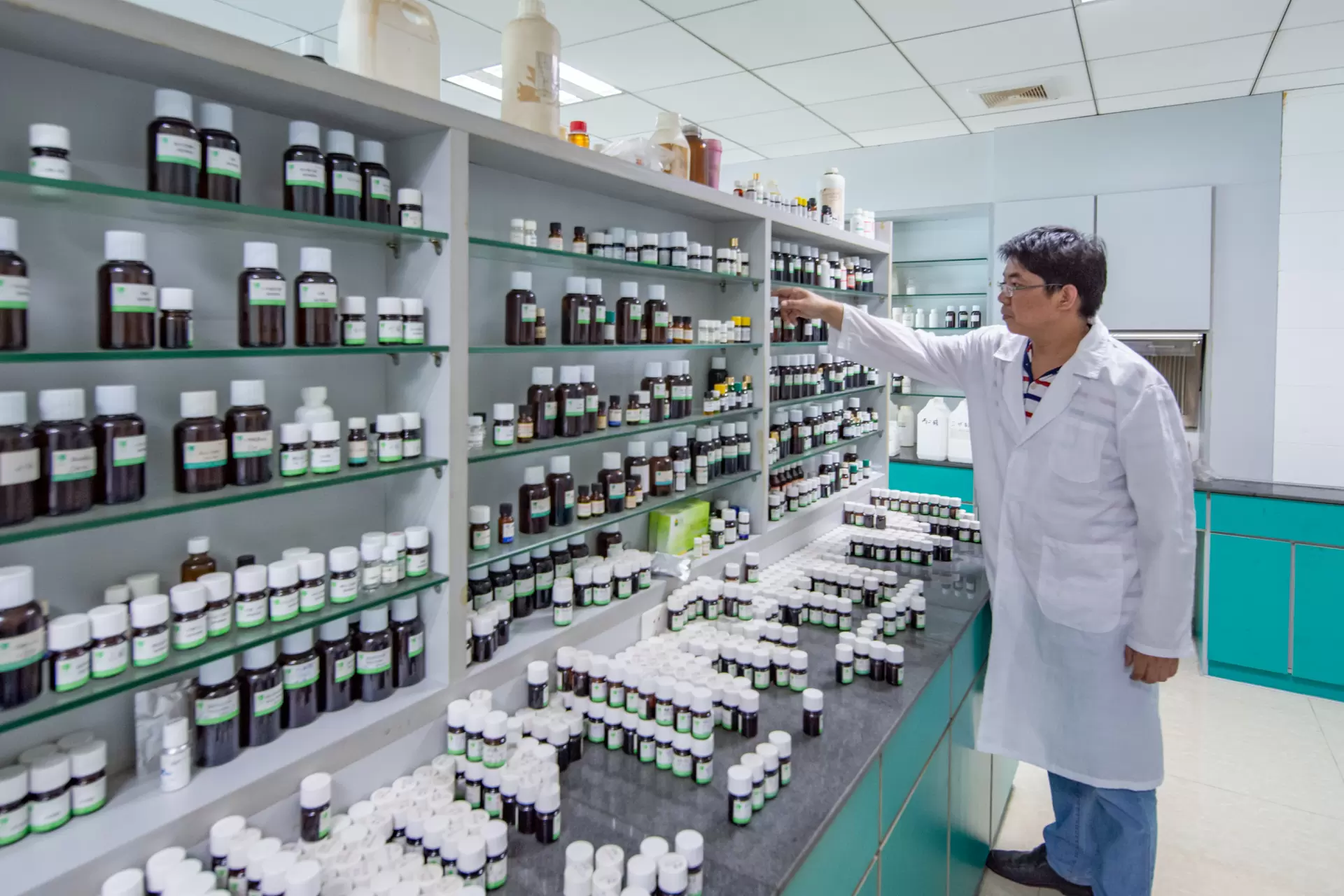
Flavor sample library in the LULIN laboratory
| Condition | Possible change | Comparison to run |
|---|---|---|
| Pasteurization, hot fill, or UHT | Top-note loss and cooked fruit | Pre-process versus post-process at the same age |
| Baking or cooking | Jam development, browning, or bitter edge | Flavor before heat versus protected or post-process addition |
| High shear or homogenization | Faster dispersion, droplet change, or aroma stripping | Bench mixing versus process-representative pass |
| Acid hold | Brighter sourness and later profile drift | Day 0 versus planned acid residence |
| Freeze-thaw | Phase separation or delayed release | Fresh, frozen, and thawed samples when relevant |
| Oxygen and light | Faded berry, cardboard, or oxidative notes | Low-headspace reference versus normal package |
| Package contact | Sorption, permeation, or liner interaction | Glass reference versus production container |
| Storage | Gradual loss or longer cooked finish | 0 days, 7 days, 14 days, 28 days, 56 days, and 90 days at 4 °C, 20 °C, and 25 °C |
Record addition order, mixing time, hydration, shear, peak temperature, hold time, cooling rate, carbonation, fill temperature, headspace, package material, and closure. Bakery projects should record batter or syrup temperature and bake time. Powder projects should record water temperature and reconstitution time. A dark purple appearance can raise expected intensity even when aroma has faded, so score appearance separately from blind flavor.
How should buyers compare blueberry samples in the real application base?
Controls reveal matrix effects. Compare coded samples in the finished base: clean control, current or reference flavor, and dose ladder. Prepare by mass with identical lots, fixed equilibration, production vessels, and intended serving temperature.
| Code | Sample construction | Purpose | Minimum observations |
|---|---|---|---|
| C0 | Finished base without blueberry flavoring | Shows the matrix’s own aroma and aftertaste | pH, °Brix, viscosity, appearance, sensory profile |
| C1 | Current or reference blueberry system | Sets the comparison denominator | Dose, lot, process, package, sensory scores |
| T1 | Candidate at 0.05% liquid or 0.25% powder | Low-impact starting point | Identity, top, body, finish, physical fit |
| T2 | Candidate at 0.10% liquid or 0.50% powder | Reference benchmark screen | Same measures plus cost-in-use estimate |
| T3 | Candidate at 0.20% liquid or 0.75% powder | Stronger direction if the base suppresses fruit | Carrier, bitterness, color, aftertaste |
| T4 | Candidate at 0.40% liquid or 1.00% powder | Escalation point for a difficult base | Use only after item-specific technical review |
Use a 0–10 anchored scale: 0 = not perceived, 3 = distinct but acceptable, 5 = rejection threshold, 7 = strong, and 10 = extreme. Score blueberry identity, floral/green lift, ripe body, acidity, sweetness, cooked note, bitterness, astringency, mouth-coating, appearance, and overall balance at 0 s, 2 s, 10 s, 30 s, and 60 s. Add 90 s or 120 s for a persistent dairy, protein, or candy finish.
A paired comparison asks which code is closer to the benchmark; a triangle test establishes whether one sample differs from two identical samples. ISO 4120:2021, ISO 13299:2016, ISO 8586:2023, and ASTM E1871-17 are useful methods for a sensory or quality team. Repeat the winner on process-representative equipment and in the production package.
What should a buyer include in a blueberry flavoring RFQ?
Define one product. The RFQ also needs one sensory target, one process, one market, and one decision date. This focus lets a supplier choose a relevant format instead of a generic berry sample.
| RFQ field | Details to provide | Why it matters |
|---|---|---|
| Finished product | Beverage, sparkling drink, yogurt, ice cream, bakery, filling, syrup, gummy, hard candy, sauce, seasoning, or dry mix; serving size and temperature | Sets release and format requirements |
| Sensory target | Fruit reference, top/middle/base notes, intensity, acid, sweetness, finish, color, benchmark | Converts “blueberry” into a scoreable brief |
| Formula | Water, fat, protein, sugar/°Brix, salt/minerals, acid/pH, alcohol, gums, and competing flavors | Predicts suppression and interaction |
| Process | Mixing, hydration, shear, homogenization, pasteurization, UHT, baking, cooking, freezing, cooling, carbonation, and fill | Determines process-survival tests |
| Format | Liquid, powder, emulsion, oil-soluble, water-soluble, encapsulated, or open to review | Narrows carrier and handling choices |
| Evaluation | Controls, dose ladder, panel date, pilot date, acceptance limits, and package | Makes the decision repeatable |
| Market and label | United States, Canada, EU, or another market; language and customer wording | Directs market and label review |
| Documents | COA, SDS/MSDS, TDS, allergen, natural/artificial wording, Halal, Kosher, vegan, non-GMO, organic, or country-specific files as required | Defines the QA file request |
| Commercial plan | Trial and production quantity, packaging preference, storage route, target cost-in-use, purchasing stage | Frames MOQ, price, lead-time, and logistics questions |
For U.S. products, ask QA to review the composition under 21 CFR 101.22 and applicable material from the U.S. Food and Drug Administration (FDA) or Flavor and Extract Manufacturers Association (FEMA). For EU projects, review Regulation (EC) No 1334/2008 with the importer. The FDA labeling rule and FEMA Flavor Ingredient Library are starting references, not a substitute for item-level review.
LULIN FLAVOR is the English brand of QUANZHOU LVLIN BIOENGINEERING CO., LTD., established in 2001 in Quanzhou, Fujian, China. The company develops, produces, and sells food-grade flavors and daily-use fragrances. Its public company profile describes 12+ engineers with 20+ years of flavor development and application experience, 3 modernized production lines, 50+ employees, a 6-acre factory area, and more than 8,000 m² of building area. Food categories include beverage, candy and confectionery, bakery, and sparkling-wine or carbonated alcoholic beverage flavors. Its application laboratory can refine, adjust, and create formulas and keeps mature formulas for reference.
Documents follow the item. Company capability does not set a universal dose, certification, MOQ, price, package, shelf life, storage condition, or schedule. Ask for those details in the RFQ. Use formulation support for R&D for matrix adjustment and the compliance document guide for files.
Frequently Asked Questions About Blueberry Flavoring
What is blueberry flavoring used for in B2B food production?
Blueberry flavoring builds a defined blueberry aroma and taste in beverages, dairy desserts, bakery products, fillings, syrups, confectionery, sauces, and dry mixes. The suitable profile and format depend on the finished matrix, process, serving temperature, target market, and label wording.
How should a buyer describe a blueberry flavor profile?
State the fruit reference, ripeness, top aroma, mid-palate body, acidity, sweetness, finish, color expectation, blend role, and serving temperature. A sentence such as “ripe highbush blueberry with a floral 0–2 second lift and clean jam finish at 4 °C” gives the panel a scoreable target.
Is blueberry flavoring the same as blueberry extract or juice concentrate?
No. Flavoring is a formulated aroma-and-taste system, while an extract or juice concentrate carries a different mix of fruit solids, color, acidity, and process behavior. Compare aroma, taste, solids, color, stability, and cost-in-use in the finished product before choosing one.
Which format should a buyer test first: liquid, powder, emulsion, oil-soluble, or water-soluble?
Match the format to the product phase and factory route: water-soluble liquid for many water systems, oil-soluble liquid for fat systems, emulsion for controlled dispersion, and powder for dry blends. Confirm carrier, solubility, heat response, storage, and handling in the actual formula.
What starting dosage should be screened for blueberry flavoring?
Screen 0.05%, 0.10%, 0.20%, and 0.40% w/w for liquid, using 0.10% as a liquid reference benchmark; screen 0.25%, 0.50%, 0.75%, and 1.00% w/w for powder, using 0.50% as the high-end design benchmark. Confirm the selected item’s technical guidance before scale-up.
How do pH, sugar, fat, and protein affect blueberry flavor?
Acid can sharpen fruit, sugar can add body while muting freshness, fat can delay release, and protein can bind aroma or add a competing aftertaste. Hold production values constant during the first comparison, then bracket one variable at a time with measured pH, °Brix, fat, and protein.
Can blueberry flavoring survive baking, pasteurization, or UHT?
It can be evaluated for those processes, but survival depends on composition, addition point, peak temperature, hold time, shear, cooling, package, and storage. Compare pre- and post-process samples and retain a production-package sample before approving a heat-stability statement or final dose.
How should blueberry flavor samples be compared?
Use coded samples in the real application base with a clean control, a current or reference flavor, and a dose ladder. Score aroma, attack, body, acidity, sweetness, finish, aftertaste, appearance, and process fit at fixed temperatures and time points, then repeat the selected treatment on a pilot.
What should be sent to a blueberry flavoring supplier in an RFQ?
Send the application, sensory direction, formula variables, process, preferred format, destination market, label route, sample quantity, pilot date, and acceptance criteria. List the required COA, SDS/MSDS, TDS, allergen, natural/artificial, Halal, Kosher, vegan, non-GMO, organic, or country-specific documents for the selected item.
Can LULIN FLAVOR develop a custom blueberry flavoring direction?
LULIN FLAVOR provides food-flavor development and application support, including formula refinement and creation through its application laboratory. Send the finished base, blueberry sensory sentence, process, target market, and sample request so the team can discuss a suitable development route and item-specific technical and commercial information.
Set the next blueberry flavoring test
Test before purchasing. Prepare a one-page brief with the fruit direction, top/middle/base notes, matrix, process, serving temperature, market, format, dose ladder, controls, documents, pilot date, and purchasing stage. Use 0.10% w/w (1 g/kg) as the liquid reference benchmark and 0.50% w/w (5 g/kg) as the high-end design benchmark for a demanding screen. LULIN FLAVOR can discuss a liquid, powder, emulsion, oil-soluble, water-soluble, or custom direction. Start with the B2B sample request or contact LULIN FLAVOR.