Published
Smoke Flavoring
Smoke flavoring is a concentrated system for building a defined wood-smoke, grill, char, or roasted profile without relying on a conventional smoker. Use 0.50% w/w (5 g/kg) as a high-end reference benchmark for initial application screening, then select the lowest level that survives processing without turning acrid, medicinal, bitter, or ashy.
Last updated: August 31, 2026
Within flavor concentrates for food manufacturing, smoke systems require a defined phase, carrier, process tolerance, label route, and evaluation condition. Smoke is temporal.
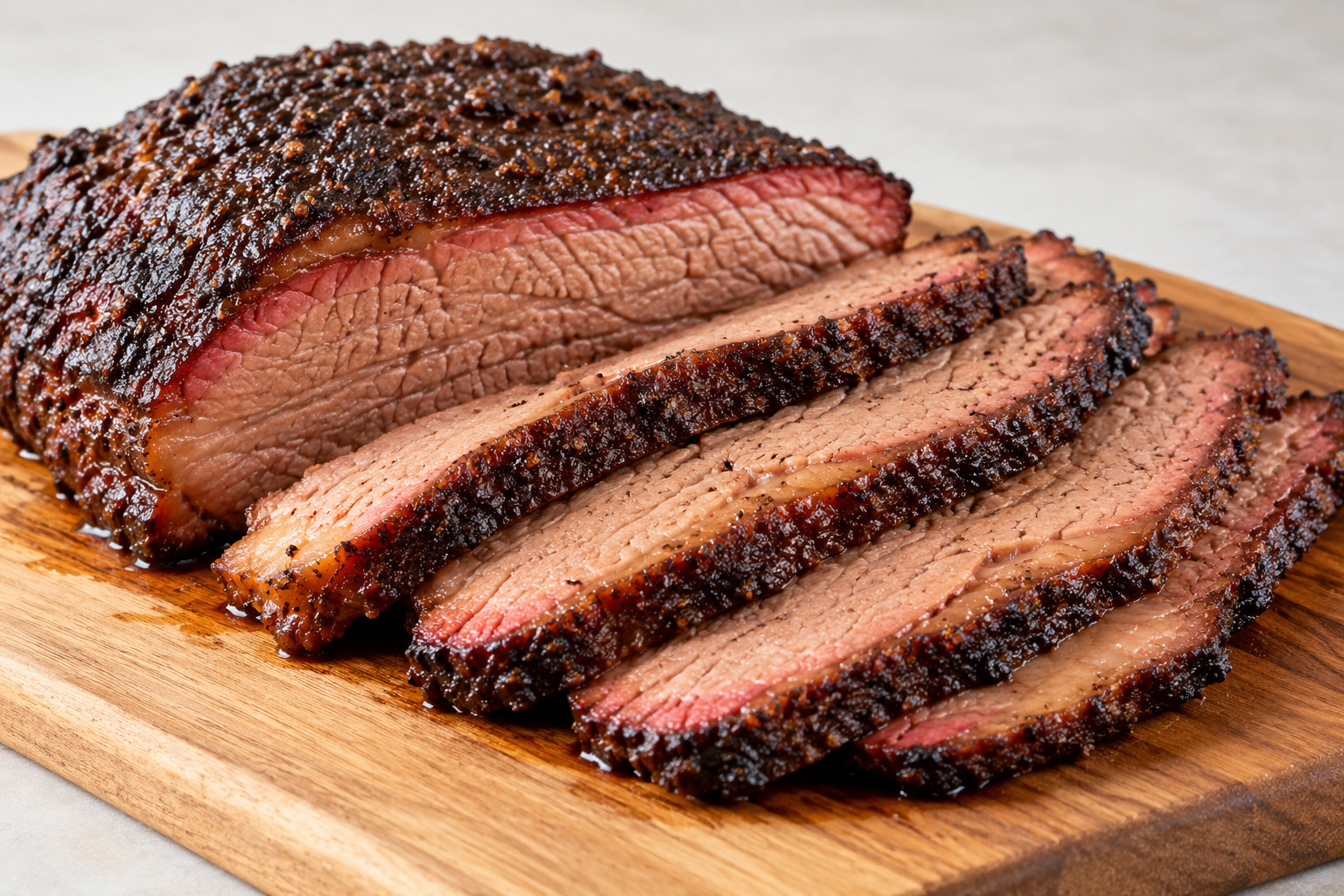
Smoked-food application: a sensory reference for defining the target flavor profile.
How should a smoke flavor profile be described without vague sensory adjectives?
A smoke flavor profile should specify source direction, combustion character, timing, intensity, mouthfeel, finish, and rejection cues. “Authentic” or “strong” does not distinguish dry wood, sweet smoke, bacon-like hickory, blackened grill, or a low-phenolic roast.
A useful brief separates aroma timing into top, middle, and base notes. Top notes are the first volatile impression before and immediately after the bite. Middle notes connect smoke to salt, fat, sweetness, meatiness, spice, or fermentation. Base notes determine length, dryness, ash, char, and the final phenolic impression.
| Smoke direction | Top-note target | Middle-note target | Base-note target | Reject if the sample becomes |
|---|---|---|---|---|
| Clean hardwood | Freshly split wood, light smoke | Dry oak or beech, restrained roast | Short, clean, low-ash finish | Damp, stale, creosote-like |
| Hickory barbecue | Immediate sweet smoke | Bacon-like, caramelized, savory | Rounded wood and long grill finish | Syrupy, hammy, overly phenolic |
| Mesquite grill | Sharp dry smoke, fast onset | Earthy char and seared crust | Persistent mineral ash | Burnt rubber, solvent-like, metallic |
| Fruitwood smoke | Mild sweet lift | Applewood- or cherrywood-style roast | Soft woody warmth | Perfumed, candy-like, thin |
| Charred roast | Toasted edge, little sweetness | Blackened crust, coffee-like roast | Dry carbon, lingering char | Sooty, bitter, mouth-drying |
| Savory background smoke | Low top-note impact | Broth, spice, fermented or meaty depth | Subtle warm finish | Dominant smoke that masks the base |
Wood names in a brief describe a target direction unless the supplier’s source statement supports literal provenance. “Hickory-style” is a sensory instruction; “derived from hickory wood” is a composition claim. Pair the target with exclusions: “medium hickory-style smoke; sweet top, grilled middle, dry short base; no medicinal, tarry, ashy, or ham-cure note.”
How do water, fat, protein, sugar, salt, acid, and serving temperature alter smoke perception?
Water, fat, protein, sugar, salt, acid, and serving temperature change dilution, partitioning, binding, volatility, taste balance, and aroma release. Context changes everything. Plain water is only a raw-material screen.
| Matrix variable | Typical effect on smoke perception | Common failure mode | Practical comparison control |
|---|---|---|---|
| Water | Dilutes acids, carbonyls, and phenolics; exposes sharp top notes | Thin, sour, harsh, short | Match total water and dissolved solids |
| Fat | Retains less-polar aroma compounds and delays release | Heavy, waxy, overly persistent finish | Match fat type, percentage, and emulsion state |
| Protein | Binds or reacts with aroma compounds; creates its own cooked notes | Muted top, uneven roast, dairy or plant off-note clash | Match protein source, level, hydration, and heat history |
| Sugar | Rounds acidity and bitterness; supports caramelized associations | Sweet barbecue effect where dry smoke was intended | Match sugar type, °Brix, and thermal history |
| Salt | Raises savory impact and can sharpen roast perception | Phenolic edge becomes aggressive or cure-like | Match sodium level and salt distribution |
| Acid | Brightens top notes and changes protein/emulsion behavior | Sour smoke, astringency, protein destabilization | Match pH, titratable acidity, and acid type |
| Serving temperature | Heat raises volatile release; cold suppresses aroma and lengthens fat melt | Hot sample seems strong, cold product seems absent, or vice versa | Evaluate at the actual consumption temperature |
Sugar may hide bitterness in a warm sauce, while fat can soften onset and extend aftertaste. Acidic concentrates should be dispersed before contacting a sensitive protein phase. Compare the intended serving condition, using 5°C, 22°C, or 60°C as reference points when chilled, ambient, and hot service all matter.
Timing changes perception.
For structured diagnosis, choose only the rows relevant to the product and change one variable at a time. The values below are a development grid, not a universal formula or shelf-life protocol.
| Challenge variable | Reference levels for a controlled screen |
|---|---|
| Smoke dosage | 0.05%, 0.10%, 0.20%, 0.35%, 0.50% |
| Added water | 0%, 10%, 25%, 50% |
| Fat | 0%, 5%, 10%, 20% |
| Protein | 0%, 5%, 10%, 15% |
| Sugar | 0%, 5%, 10%, 20% |
| Salt | 0%, 0.5%, 1.0%, 2.0% |
| Alcohol | 0%, 5%, 10%, 20% |
| Carrier pre-dilution | 1%, 5%, 10%, 20% |
| Emulsion oil phase | 5%, 10%, 20%, 30% |
| Seasoning pickup | 2%, 5%, 8%, 12% |
| Oil spray | 0.5%, 1.0%, 1.5%, 2.0% |
| Dry-system moisture | 2%, 5%, 10%, 15% |
| Serving temperature | 5°C, 22°C, 40°C, 60°C |
| Wet-process temperature | 25°C, 85°C, 95°C, 121°C |
| Wet-process hold | 15 s, 30 s, 5 min, 15 min |
| Baking temperature | 150°C, 180°C, 200°C, 220°C |
| Extrusion temperature | 90°C, 120°C, 150°C, 180°C |
| Freeze/thaw condition | -18°C, 4°C, 22°C, 60°C |
| Mix time | 30 s, 2 min, 5 min, 10 min |
| Open exposure | 0 min, 5 min, 15 min, 30 min |
| Protein hydration | 15 min, 30 min, 60 min, 120 min |
| Cooling time | 5 min, 15 min, 30 min, 60 min |
| Initial storage | 0 days, 1 day, 7 days, 28 days |
| Accelerated temperature | 22°C, 30°C, 37°C, 45°C |
| Package headspace | 5%, 10%, 25%, 50% |
| Post-process reading | 0 h, 24 h, 72 h, 168 h |
| Recovery time | 1 h, 4 h, 24 h, 72 h |
| Pack size | 100 g, 500 g, 5 kg, 25 kg |
| Batch scale | 1 kg, 10 kg, 100 kg, 1,000 kg |
For complex bases, food flavor formulation support for B2B R&D can connect the sensory brief with pH, fat, protein, processing, and addition order before a second sample round.
Which smoke flavoring format should a food manufacturer test?
A food manufacturer should match the continuous phase and handling step: water-soluble liquid, oil-soluble liquid, emulsion, spray-dried powder, or plated/absorbed powder. Phase fit comes first. These five industry options are not interchangeable.

Flavor sample library in the LULIN laboratory
| Format option | Best first application | Main strength | Main limitation | Critical supplier question |
|---|---|---|---|---|
| water-soluble liquid | Sauces, brines, soups, beverages, wet marinades | Fast dispersion and easy bench adjustment | Can create local acidity or a sharp top note | What are pH, carrier, phenol profile, and addition order? |
| oil-soluble liquid | Snack oils, fat fillings, oil marinades, savory coatings | Direct delivery into the lipid phase | Poor water dispersion without another system | Is the material oil-soluble or only oil-dispersible? |
| emulsion | Mixed water/fat sauces, dressings, injection systems | Bridges phases and can improve uniformity | Shear, salt, heat, and pH can break the emulsion | What droplet system and process window apply? |
| spray-dried powder | Dry seasonings, soups, premixes, extruded snacks | Meterable dry addition and reduced liquid handling | Carrier dilutes potency; heat and humidity can release aroma early | Which carrier, moisture target, and particle size are used? |
| plated/absorbed powder | Rubs, spice blends, low-water dry mixes | Simple dry blending and strong initial impact | Volatiles may migrate; flow and dusting can vary | Which substrate holds the liquid and how is caking controlled? |
The JECFA smoke flavourings monograph covers aqueous fractions, vegetable-oil extracts, polysorbate systems, and dry carriers such as yeast, flour, salt, phosphates, and carbohydrates. Format therefore affects claim review and cost-in-use. A powder used at 0.80% can cost more per 1,000 kg of food than a liquid used at 0.15%. The powder versus liquid food flavor guide covers the wider handling decision.
What processing and storage conditions can shift the intended smoke profile?
Heat, oxygen, light, moisture, shear, addition order, packaging, and time can shift smoke toward weak, sour, stale, ashy, or medicinal. Process loss is selective. Bottle smelling is insufficient.
| Condition to reproduce | What may change | Diagnostic trial | Useful decision signal |
|---|---|---|---|
| Pasteurization or hot fill at 85–95°C | Volatile top notes fall; cooked middle notes rise | Compare pre- and post-heat aroma at equal temperature | Retained character after 24 hours |
| Retort near 121°C | Severe top-note loss; base fractions dominate | Process the full package, not an open beaker | Absence of tarry or metallic finish |
| Baking or surface heating above 150°C | Volatiles escape; crust reactions add roast | Test flavor in dough and post-bake surface systems | Correct smoke after cooling, not at oven exit |
| Extrusion with heat and shear | Flash-off, carrier rupture, uneven distribution | Dose pre-extrusion and compare with post-coating | Best location for flavor addition |
| Frying and hot oil contact | Oil partitioning and oxidation alter finish | Evaluate fresh and after the normal hold time | Stable grill note without rancid overlap |
| High-shear emulsification | Dispersion improves or emulsion structure fails | Match rotor speed, time, and order of addition | No ring, separation, or hot spot |
| Oxygen and light during storage | Oxidation dulls wood notes and creates stale character | Compare barrier package with normal package | Sensory retention at defined checkpoints |
| Humidity in dry systems | Powder cakes and releases volatiles into headspace | Store in final packaging at target humidity | Flow, dose uniformity, and retained aroma |
Premixing an acidic liquid into water, oil, or a compatible slurry reduces local shock. Late addition can protect volatile top notes where process controls permit it. Test the commercial pack and headspace at 24 h, 7 days, and validated shelf-life intervals; dry powders also need flow, caking, and headspace-aroma checks.
How should buyers compare smoke flavor samples in the real application base?
Buyers should use a controlled dose ladder, identical processing, coded presentation, intended serving temperature, and a scorecard for onset, body, finish, off-notes, appearance, and cost. Blind coding prevents bias. The lowest passing dose is usually the strongest commercial choice.
Use this six-step application screen:
- Make one homogeneous base batch; hold pH, salt, sugar, fat, protein, solids, color, and water constant.
- Include a control, then test 0.05%, 0.10%, 0.20%, 0.35%, and 0.50% w/w. The 0.50% level equals 5 g/kg and is the high-end reference benchmark.
- Keep carrier dilution, addition order, mix time, temperature, and coding identical.
- Run the full pasteurization, retort, baking, extrusion, frying, chilling, or freezing process.
- Taste blind at the serving temperature after processing, after 24 h, and at the first storage checkpoint.
- Pilot the lowest passing level; calculate flavor cost per 1,000 kg of food.
| Scorecard dimension | 0 anchor | 5 anchor | 10 anchor | Decision use |
|---|---|---|---|---|
| Smoke onset | None | Clear after first bite | Dominates before tasting | Sets top-note strength |
| Integrated smoke body | Disconnected | Balanced with base | Masks the application | Tests middle-note fit |
| Finish length | Disappears immediately | Persists appropriately | Lingers unpleasantly | Controls base-note load |
| Harshness | Clean | Noticeable edge | Acrid, medicinal, bitter, or ashy | Establishes rejection point |
| Base compatibility | Clashes | Supports core flavor | Replaces core flavor | Protects product identity |
| Process retention | Lost | Acceptable | Strong but distorted | Identifies format or addition-step issue |
Compare suppliers first at equal weight, then at each sample’s lowest passing level and equal finished-product cost. Include carrier load, process loss, batch consistency, packaging, and document fit.
What belongs in a smoke flavoring RFQ for a U.S. or export launch?
A smoke flavoring RFQ should state the sensory target, matrix, process, format, dosage screen, market, label plan, documents, volume, and delivery conditions. The brief controls relevance.
| RFQ field | Exact information to send | Why it changes the supplier response |
|---|---|---|
| Sensory target | Wood direction, top/middle/base notes, intensity 0–10, rejection cues | Selects the correct smoke fraction and profile |
| Finished matrix | Water, fat, protein, sugar, salt, acid, pH, solids | Determines phase behavior and masking |
| Process | Time, temperature, shear, pressure, addition step, package | Screens retention and physical stability |
| Format | One or more of the five named options; carrier restrictions | Prevents a phase or handling mismatch |
| Trial design | Dose ladder, control, benchmark, serving temperature, scoring method | Makes sample feedback comparable |
| U.S. label route | FDA food category, intended ingredient declaration, natural/artificial target | Frames the regulatory document review |
| Meat or poultry scope | Species, product standard, USDA-FSIS label route, surface or formula addition | Identifies special naming and label questions |
| Export destination | Country, food category, importer checklist, launch date | Prevents U.S. status from being applied abroad |
| Technical file | TDS/specification, SDS, COA, carrier and ingredient statement, allergen, GMO, vegan, origin, shelf life, storage | Supports R&D, QA, and importer review |
| Smoke-specific file | Wood/source statement, composition markers, PAH data, use conditions, regulatory status | Distinguishes purified food-grade material from a generic smoke claim |
| Commercial plan | Sample quantity, first order, annual forecast, pack size, Incoterm, destination, deadline | Establishes MOQ, price, lead time, and freight basis |
For U.S. conventional foods, 21 CFR 101.22 defines natural flavor by source and process, including certain products of heating derived from plant material. Labels follow composition. FDA’s GRAS framework evaluates intended conditions of use.
USDA-FSIS rules apply separately to meat and poultry. Formula addition, surface treatment, and conventional smoking can create different label questions. State the species, standard of identity, application method, and proposed label.
Destination rules differ. Commission Implementing Regulation (EU) 2024/2067 deleted SF-001 through SF-010 from the European Union list. General-category placement ended July 1, 2026; specified cheese, meat, processed fish, and fish-roe categories run through July 1, 2029. Qualifying food placed by its deadline may remain until its durability or use-by date. Great Britain keeps a separate register. The food flavor compliance document request guide separates these routes.
Where does smoke flavoring fit, and where does it fail?
Smoke flavoring fits products needing controlled smoky character and repeatable application; it fails when expected to reproduce every color, texture, preservation, and process effect of smoking. Flavor is one outcome.
| Application | Useful smoke direction | Process focus | Format to screen first | Frequent failure |
|---|---|---|---|---|
| Meat and plant-protein products | Hickory, grill, roasted savory | Protein binding, cook loss, fat release | water-soluble liquid or emulsion | Cure-like note, beany clash, uneven hot spots |
| Barbecue sauce and marinade | Sweet smoke, oak, char | pH, sugar, salt, hot fill | water-soluble liquid | Smoke disappears in sweetness or turns sour |
| Chips, nuts, and extruded snacks | Dry grill, mesquite, bacon-like | Oil adhesion, extrusion, oxidation | oil-soluble liquid or spray-dried powder | Headspace loss, surface bitterness, dusting |
| Cheese sauce and dairy-style foods | Soft wood, gentle roast | Fat retention, protein stability, serving heat | emulsion or water-soluble liquid | Long medicinal finish or protein shock |
| Soups, noodles, and ready meals | Savory background smoke | Retort, salt, broth, package storage | spray-dried powder or heat-tolerant liquid | Flat top, metallic base, excessive persistence |
| Seasonings and dry blends | Char, barbecue, roasted spice | Carrier, humidity, blend uniformity | spray-dried powder or plated/absorbed powder | Caking, migration, nonuniform dose |
This page covers smoke sensory architecture, matrix effects, process survival, formats, and RFQ evidence. The guide to what artificial flavor means in food covers natural-versus-artificial definitions across flavor categories.
Frequently asked questions about smoke flavoring
What is natural smoke flavor?
Natural smoke flavor is a preparation whose source and manufacturing route support the destination market’s natural-flavor definition. In the United States, 21 CFR 101.22 applies to the exact source, process, carrier, and food context. The phrase alone does not identify wood species, solubility, strength, or permitted use.
Is natural smoke flavor vegan?
Natural smoke flavor can be vegan, but wood-smoke origin does not prove the full preparation is vegan. Carriers, emulsifiers, processing aids, compound ingredients, and cross-contact language must cover the product code. Request a current vegan or material-origin statement for the exact liquid, emulsion, or powder.
Is natural smoke flavor gluten-free?
Natural smoke flavor can be gluten-free, but the claim is item-specific. JECFA recognizes dry preparations using flour, salt, yeast, phosphates, or carbohydrates as carriers. Request the ingredient/carrier statement, allergen declaration, cross-contact wording, and the gluten claim required by the finished-food program.
Is smoke flavoring safe, and is it carcinogenic?
Food-grade smoke flavoring is assessed by composition, purity, exposure, and conditions of use; “smoke” is not a blanket safety conclusion. Purification reduces polycyclic aromatic hydrocarbons, while PAH specifications still matter. Obtain current use conditions, PAH data, regulatory documents, and destination-market review for the selected item.
How much smoke flavor should a formulator add?
Use 0.50% w/w, equal to 5 g/kg, as a high-end screening benchmark, not a universal formula. Test 0.05%, 0.10%, 0.20%, 0.35%, and 0.50% in the real base, then approve the lowest level that survives processing without harshness or masking.
What is natural hickory smoke flavor?
Natural hickory smoke flavor may be derived from documented hickory or designed toward a hickory sensory profile. Those claims differ. State whether hickory provenance is mandatory or whether the actual target is a sweet, bacon-like, rounded hardwood direction.
Can smoke flavor replace conventional smoking?
Smoke flavor can replace or supplement flavor delivery, but it does not reproduce conventional smoking’s color, dehydration, texture, microbial effects, or process identity automatically. Validate flavor, appearance, preservation controls, product naming, and labeling separately.
Which smoke flavor format works best for snack seasoning?
Oil-soluble liquid and spray-dried powder are the first candidates for snack seasoning. Use liquid with a controlled oil spray and powder in a dry blend. Compare adhesion, headspace loss, oxidation, carrier taste, dusting, caking, and distribution after the normal packaging hold.
What documents should a smoke flavor supplier provide?
A smoke flavor supplier should provide TDS/specification, SDS, COA, carrier/ingredient and allergen statements, storage guidance, use conditions, source statement, PAH information, and market status. Add vegan, non-GMO, Halal, Kosher, origin, label, and batch documents as required.
Turn the smoke brief into a sample decision
LULIN FLAVOR is the English brand of QUANZHOU LVLIN BIOENGINEERING CO., LTD., a Quanzhou, Fujian food-grade flavor manufacturer established in 2001. Its base includes 3 production lines, more than 50 employees, over 8,000 m² of building area, and more than 12 application engineers with over 20 years of flavor-development experience.
LULIN supplies water-soluble, oil-compatible, emulsion, spray-dried, and plated powder formats. Sample briefs receive a technical response within 2 business days; matched samples dispatch within 5 business days. Standard MOQ is 25 kg per item, with a 10–15 business day production lead after approval.
The qualification pack includes ISO 9001 and HACCP documentation, item-specific TDS, SDS, representative COA, carrier/ingredient and allergen statements, source information, PAH data, and destination-market files. Pricing uses format, dosage, volume, pack, Incoterm, and destination so buyers can compare finished-product cost.
Send the matrix, process, top/middle/base target, intensity, rejection cues, format, market, documents, destination, and forecast. Use the B2B food flavor sample request for a trial brief or contact LULIN FLAVOR for qualification and export work.
Develop this flavor in your product
Send your product, target market and project goal. We will review the sample direction with you.